
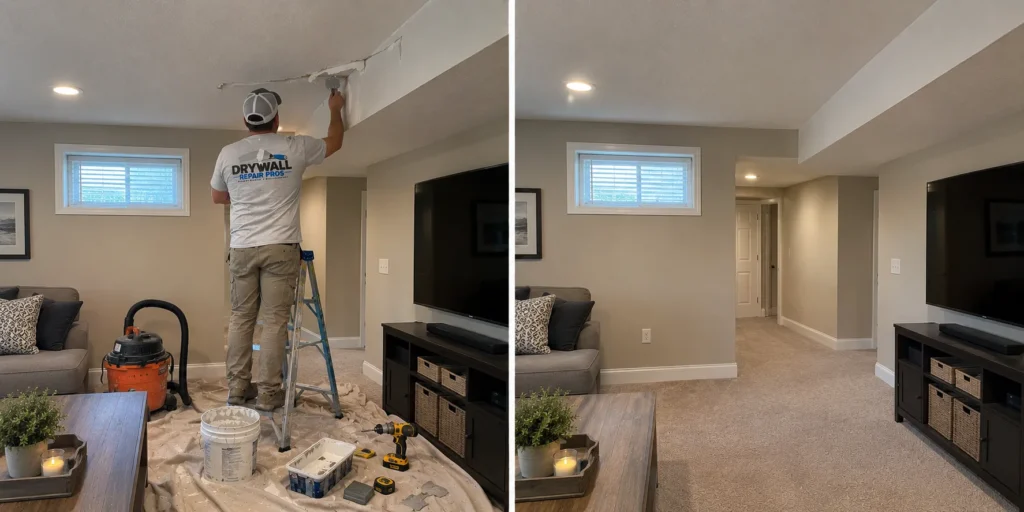
Professional Ceiling Texture Repair & Matching in Cedar Rapids & Iowa City
Ceiling texture repairs can be difficult to hide because overhead lighting, windows, and long sight lines make small differences in pattern, surface height, and texture density easy to see. A ceiling patch may be structurally sound but still look unfinished if the surrounding texture is not restored.
Drywall Repair Pros provides professional ceiling texture repair and matching throughout Cedar Rapids, Iowa City, and surrounding communities. We repair missing or damaged ceiling texture, smooth patches in textured ceilings, orange peel, knockdown, spray, stipple, roller, brush, swirl, and other hand-applied ceiling finishes.
The goal is to restore the finished ceiling so the repaired area blends naturally with the surrounding surface instead of remaining as an obvious patch, hard-edged texture spot, or mismatched pattern.
Get a Fast Ceiling Texture Repair Quote From Photos
Most visible ceiling texture repairs can be initially reviewed from photos and basic measurements. Send a straight-on close-up of the texture, one or more angled photos that show texture depth and shadows, and a wider room photo that shows the repair in relation to the entire ceiling.
Include the approximate width and height of the repair, ceiling height, the texture type if known, whether the texture is light, medium, or heavy, whether the underlying drywall repair is complete, whether water damage was involved, whether the area has been repaired before, and whether the ceiling has been painted multiple times.
Photos taken from different directions are especially useful on ceilings because the same repair can look different under window light, recessed lighting, and ceiling fixtures. In many cases, this information is enough for same-day initial pricing without a separate estimate visit.
Ceiling Texture Repair
Ceiling texture can be damaged by holes, patches, cracks, plumbing or roof leaks, electrical access, remodeling, fixture changes, ceiling fan work, recessed lighting, wall or soffit removal, sanding, scraping, and previous repairs.
The underlying ceiling should be stable, properly repaired, and appropriately dry before texture is restored. Texture should be the finishing step, not a way to hide loose drywall, raised patches, failed tape, active cracks, or other unfinished ceiling problems.
Ceiling Texture Matching
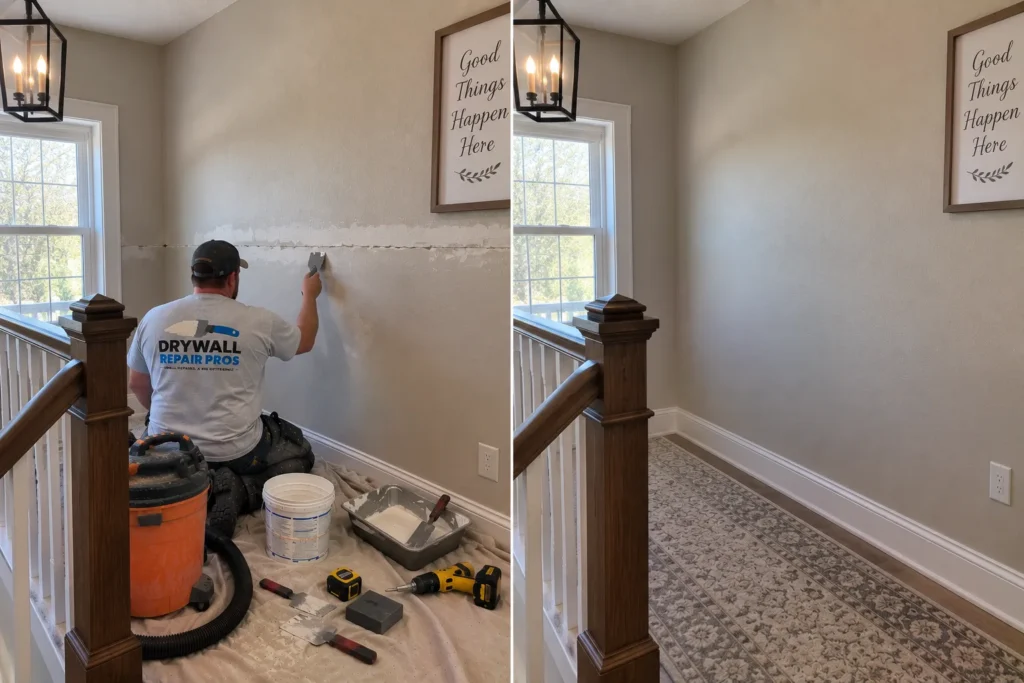
Matching ceiling texture means recreating the existing finish as closely as practical. The surrounding ceiling should guide the repair rather than using a generic texture pattern.
Important factors include texture type, pattern, density, thickness, direction, application method, paint buildup, age, previous repairs, surface height, and lighting conditions. Ceiling texture can vary even within the same home, so the immediate repair area matters most.
Why Ceiling Texture Repairs Stand Out
A ceiling texture repair may remain visible when the new texture is too heavy, too light, too dense, too sparse, the pattern size is wrong, the repair edges are too sharp, or the patch itself sits slightly high or low.
Paint buildup and directional lighting can make these differences more obvious. A wider, gradual blend often works better than stopping texture at the exact edge of a patch.
Ceiling Texture Repair After Drywall Repairs
Holes, Patches & Cracks
Ceiling hole, patch, and crack repairs usually leave a smooth finished area before texture restoration. The drywall repair should be secure, flat, taped or reinforced as needed, feathered, and sanded before the surrounding texture is recreated.
For repair-specific information, see Ceiling Hole & Patch Repair or Ceiling Crack Repair.
Leaks & Water Damage
Water can cause ceiling texture to bubble, peel, soften, stain, separate, or fall away. The leak source should be corrected and the affected drywall should be appropriately dry and stable before texture is restored.
For moisture-dominant projects, see Water-Damaged Ceiling Repair or Drywall Repair After Roof Leaks.
Plumbing, Electrical & Fixture Work
Plumbing access, electrical work, recessed lighting, fixture changes, ceiling fans, wiring access, and old electrical boxes can leave openings or disturbed texture. Once the underlying repair is complete, the surrounding ceiling texture can be matched and blended.
For trade-specific work, see Drywall Repair After Plumbing Work or Drywall Repair After Electrical Work.
Remodeling & Layout Changes
Wall removal, soffit removal, relocated fixtures, closed openings, and old-to-new drywall transitions can leave long ceiling strips or exposed areas with no matching texture. The drywall surface should be completed first, then the surrounding ceiling pattern restored.
For broader renovation repairs, see Drywall Repair After Remodeling.
Want Pricing for a Repair Like This?
Most visible repairs can start with photos. Send the property address, a short description, and up to six images.
Orange Peel Ceiling Texture Repair & Matching
Orange peel texture is used on some ceilings as well as walls. It may range from very fine and light to medium or heavy.
Matching orange peel depends on droplet size, spray density, material consistency, application distance, coverage, existing paint buildup, and transition width. A fresh spray patch can remain obvious if its density or droplet size differs from the surrounding ceiling.
The existing ceiling should determine the application settings and blend area.
Knockdown Ceiling Texture Repair & Matching
Knockdown texture begins as a sprayed or applied pattern and is partially flattened before it fully sets. Matching requires attention to pattern size, spacing, material consistency, knockdown timing, tool pressure, and the amount of flattening.
Small differences can become especially visible on ceilings because overhead and low-angle lighting cast shadows across the texture. The repair should match both the original texture pattern and how strongly it was flattened.
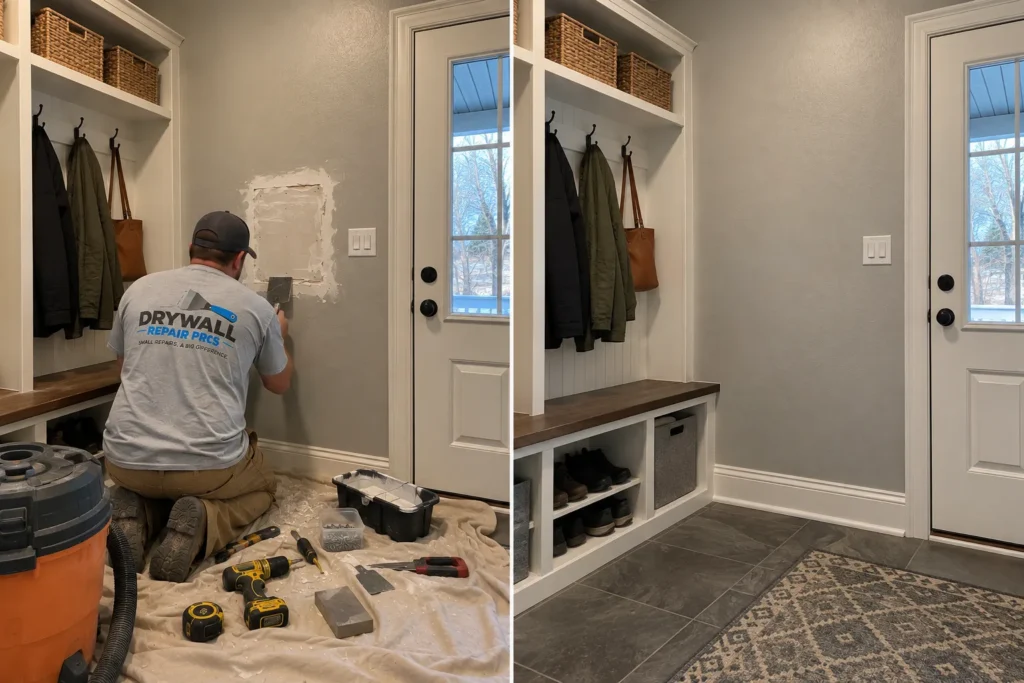
Other Ceiling Texture Types We Repair
Spray & Splatter Texture
Spray textures may include fine splatter, heavy splatter, orange peel, and knockdown. Pressure, material consistency, spray distance, coverage, masking, and pattern size all affect the result. Nearby walls, fixtures, furniture, and floors should be protected from overspray.
Stipple Texture
Stipple ceilings may use brushes, rollers, specialty tools, or texture compounds to create repeated peaks or patterned impressions. Matching depends on the shape, spacing, depth, and tool used on the surrounding ceiling.
Brush & Swirl Texture
Brush and swirl textures rely on directional movement and repetition. Similar brush width, arc size, spacing, pressure, and direction help the repair continue the existing pattern instead of looking isolated.
Roller, Trowel & Other Hand-Applied Texture
Roller, trowel, sponge, and other hand-applied ceiling textures depend on material thickness, tool type, overlap, pressure, direction, and number of passes. The application method should follow the existing ceiling as closely as practical.
Matching Ceiling Texture Weight, Density & Pattern
Light and fine ceiling textures can be difficult to match because even small differences show under side lighting. Too much material can make the repair appear heavy, while too little can leave it noticeably smoother than the surrounding ceiling.
Coarse or heavy textures require attention to pattern size, spacing, depth, and thickness. A wider blend can help prevent the repaired area from reading as a separate patch.
Repair the Ceiling First – Then Restore Texture
Texture should be restored only after the underlying ceiling defect is corrected. Seams, failed tape, nail or screw pops, cracks, loose drywall, sagging drywall, and unstable patches can all continue moving beneath new texture.
For the primary repair issue, see Drywall Seam & Joint Repair, Drywall Tape Repair, Nail Pop & Screw Pop Repair, Ceiling Crack Repair, Sagging & Loose Drywall Repair, or Ceiling Hole & Patch Repair.
Ceiling Texture Around Lights, Fans, Fixtures & Attic Access
Recessed lights, ceiling fans, electrical boxes, old fixture openings, mounting areas, and attic-access openings can disturb both the drywall and the texture around them.
Fixture replacement may expose areas with no texture, a different paint line, unfinished drywall, or previous patches hidden by a larger fixture. Once the ceiling repair is complete, the surrounding texture can often be blended locally.
Ceiling Texture After Remodeling & Removed Features
Removing an interior wall, soffit, bulkhead, cabinet, or other built-in can expose strips or sections of ceiling that were never textured or painted like the surrounding surface.
These projects may require drywall replacement or finishing first, followed by texture matching across the former wall, soffit, cabinet, or opening location.
Repairing Mismatched Ceiling Texture
Previous ceiling texture repairs may stand out because they are too heavy, too light, oversprayed, uneven, sharply defined, or based on the wrong pattern or density.
Improving an old repair may require reducing or removing part of the mismatched texture, correcting the surface underneath if needed, and rebuilding the texture with a wider and more controlled blend.
Why Does My Ceiling Texture Look Different After Repair?
Common reasons include the wrong texture type, incorrect density, different pattern size, a different application method, surface-height differences, paint buildup, or hard patch edges.
The repair can become even more obvious after painting because paint changes how the ceiling reflects light.
Why Does Ceiling Texture Look Different in Certain Light?
Ceiling surfaces are strongly affected by lighting direction. Window light, recessed lighting, ceiling fixtures, and other low-angle light can exaggerate small differences in pattern, depth, patch height, or texture density.
A repair that looks acceptable from one side of the room may be more visible from another. That is why photos from multiple angles are useful when evaluating ceiling texture repair.
Why Does Ceiling Texture Look Different After Painting?
Paint can change the way light reflects across a textured ceiling. Differences in sheen, paint thickness, primer coverage, surface absorption, and texture height can all affect the finished appearance.
Texture matching and paint matching are related but separate parts of the final result.
Can Ceiling Texture Be Matched Exactly?
An exact duplicate is not always realistic, especially when the original texture was hand-applied, has aged, has multiple coats of paint, or includes previous repairs.
Careful matching of pattern, density, depth, application method, and blend width can substantially reduce the visual difference between the repair and the surrounding ceiling.
Should Ceiling Texture Be Feathered Beyond the Patch?
Often, yes. Extending texture beyond the exact drywall patch can reduce a visible edge and make the repair transition more gradually into the surrounding ceiling.
The proper blend width depends on patch size, texture type, lighting, existing pattern, and nearby previous repairs.
How Large Should a Ceiling Texture Repair Be?
The texture restoration area may need to be larger than the drywall patch itself. A small ceiling patch can require a broader texture blend so the repair does not appear as a sharply defined island.
Larger-area texture work may also make sense when many repairs are close together or existing texture is already inconsistent.
Can Texture Be Applied Over a Smooth Ceiling Patch?
Yes. The patch should first be stable, flat, finished, sanded, clean, and properly prepared. Texture can then be applied and blended into the surrounding ceiling.
Can Ceiling Texture Hide a Bad Patch?
Texture can reduce the visibility of minor surface variation, but it will not fix raised patches, loose drywall, poorly feathered joints, deep ridges, failed tape, or unstable cracks.
The underlying ceiling repair should be corrected before texture is applied.
Does the Whole Ceiling Need to Be Retextured?
Usually not. Localized ceiling texture repair is often possible.
A larger area may make sense when many repairs are present, the existing texture is inconsistent, previous repairs cover a large section, or a localized blend would remain noticeably different from the surrounding ceiling.
Repairing Popcorn Ceiling Texture
Popcorn is a ceiling texture, but popcorn-specific repair and removal have different practical considerations from most orange peel, knockdown, stipple, and other ceiling textures.
For popcorn-specific work, see Popcorn Ceiling Repair or Popcorn Ceiling Removal.
Repair Ceiling Texture Before Painting or Selling
Ceiling texture repair should generally be completed before final painting. The normal sequence is to repair the ceiling, finish and sand the surface, restore the texture, prime when appropriate, and then paint.
Smooth ceiling patches, heavy texture spots, visible patch outlines, inconsistent density, and old water-damage repairs can also attract attention during home showings and listing photography. Correcting the ceiling texture before painting creates a more consistent finished surface.
Ceiling Texture Repair for Rental Properties
Rental properties often need ceiling texture repair after leaks, maintenance access, fixture changes, patch repairs, tenant damage, and unit turnover.
Landlords and property managers can send photos of multiple ceiling repairs at once, including ceiling height, approximate dimensions, and texture type. Most visible texture projects can be reviewed remotely for initial pricing.
Commercial Ceiling Texture Repair
Commercial spaces may require ceiling texture repair after electrical, plumbing, mechanical, tenant-improvement, fixture-relocation, remodeling, or water-damage work.
Texture consistency can be particularly noticeable in offices, retail interiors, hallways, waiting areas, and other finished spaces with large uninterrupted ceilings and bright lighting.
Ceiling Texture Repair & Matching in Cedar Rapids
Drywall Repair Pros provides ceiling texture repair, ceiling texture matching, textured ceiling repair, orange peel ceiling texture repair, knockdown ceiling repair, ceiling texture patch repair, and damaged ceiling texture repair throughout Cedar Rapids and surrounding communities.
Ceiling Texture Repair & Matching in Iowa City
We provide professional ceiling texture repair and matching throughout Iowa City and surrounding communities for homeowners, landlords, property managers, apartments, rentals, and commercial interiors. Common projects include smooth patches in textured ceilings, orange peel repair, knockdown texture matching, fixture-related texture repair, and previous mismatched ceiling repairs.
Our Ceiling Texture Repair & Matching Process
Start With Photos, Measurements & Ceiling Height
Send straight-on and angled texture photos, a wider room photo, approximate repair dimensions, ceiling height, texture type if known, light/medium/heavy density, whether the drywall repair is complete, moisture history, previous texture repairs, and whether the ceiling has multiple paint layers.
Identify the Existing Ceiling Texture. We evaluate pattern, density, depth, application method, paint buildup, lighting, and nearby previous repairs.
Confirm the Underlying Ceiling Is Stable. Texture should not be applied over loose, wet, sagging, cracked, or poorly finished drywall.
Prepare the Repair and Transition Area. The surface is finished, sanded, cleaned, flattened as needed, and feathered so the texture does not begin at a hard edge.
Recreate the Ceiling Texture. The appropriate spray, roller, brush, trowel, or other application method is selected based on the surrounding ceiling.
Blend the Texture Into the Existing Finish. The texture may extend beyond the exact patch to reduce visible boundaries and match the surrounding pattern more naturally.
Allow to Dry and Prepare for Primer or Paint. Once the texture has set, the surface can be prepared for the next finish as appropriate.
Frequently Asked Questions About Ceiling Texture Repair
Can damaged ceiling texture be repaired?
Yes. Damaged or missing ceiling texture can usually be restored after the drywall underneath is stable and properly repaired.
Can you match existing ceiling texture?
Yes, in many cases. Matching depends on recreating the pattern, density, depth, and application method while accounting for paint buildup and lighting.
Can orange peel ceiling texture be repaired?
Yes. Orange peel ceiling texture can be repaired and blended by matching droplet size, density, and transition width.
Can knockdown ceiling texture be repaired?
Yes. Knockdown can be recreated after ceiling repairs, but pattern size and the amount of flattening need to match the surrounding ceiling.
Can texture be matched over a ceiling patch?
Yes. Once the patch is stable, flat, finished, and sanded, matching texture can be applied and blended.
Why does my ceiling patch look smooth?
The drywall may have been repaired without restoring the surrounding texture, leaving a smooth area inside a textured ceiling.
Why does my ceiling texture repair look different?
The pattern, density, thickness, surface height, application method, paint buildup, or blend width may differ from the surrounding ceiling.
Can ceiling texture be repaired after water damage or a roof leak?
Yes, once the moisture source has been corrected and the ceiling drywall is dry, stable, and properly repaired.
Can ceiling texture be repaired after plumbing or electrical work?
Yes. Texture is commonly restored after plumbing access holes, wiring access, light fixtures, ceiling fans, recessed lights, and electrical boxes are repaired.
Can old ceiling texture be matched?
Often, yes, although aging, hand-applied variation, previous repairs, and multiple paint layers can make exact replication more difficult.
Should ceiling texture extend beyond the patch?
Often, yes. A wider blend can reduce visible edges and make the transition less noticeable under directional lighting.
Should ceiling texture be repaired before painting?
Yes. Texture restoration should generally be completed before primer and final paint.
Can ceiling texture repair be quoted from photos?
Usually. Straight-on and angled texture photos, a wider room view, approximate dimensions, ceiling height, repair status, texture type, water history, paint buildup, and previous repairs can often provide enough information for initial pricing.
How much does ceiling texture repair cost?
Cost depends on repair size, texture type, ceiling height, accessibility, amount of blending required, number of repair areas, previous repairs, preparation needs, and whether the underlying drywall repair is already complete. See our Drywall Repair Cost & Pricing Guide for broader pricing information.
Get a Fast Ceiling Texture Repair & Matching Quote
If you have a smooth patch in a textured ceiling, missing texture, damaged texture, orange peel, knockdown, stipple, or another ceiling texture that needs repair, you can usually start the pricing process without scheduling a separate on-site estimate.
For the fastest review, include:
- A straight-on close-up of the existing ceiling texture
- Angled photos showing texture depth and shadows
- A wider room photo showing the repair in context
- Approximate width and height of the repair area
- Approximate ceiling height
- Texture type if known
- Whether the texture is light, medium, or heavy
- Whether the drywall repair is already complete
- Whether water damage or a roof leak was involved
- Whether the ceiling has been repaired or textured before
- Whether the ceiling has multiple paint layers
- Photos of any additional ceiling texture repairs you want included
In many cases, that information is enough for same-day initial pricing. Drywall Repair Pros serves Cedar Rapids, Iowa City, and surrounding communities. For popcorn-specific work, see Popcorn Ceiling Repair or Popcorn Ceiling Removal.