
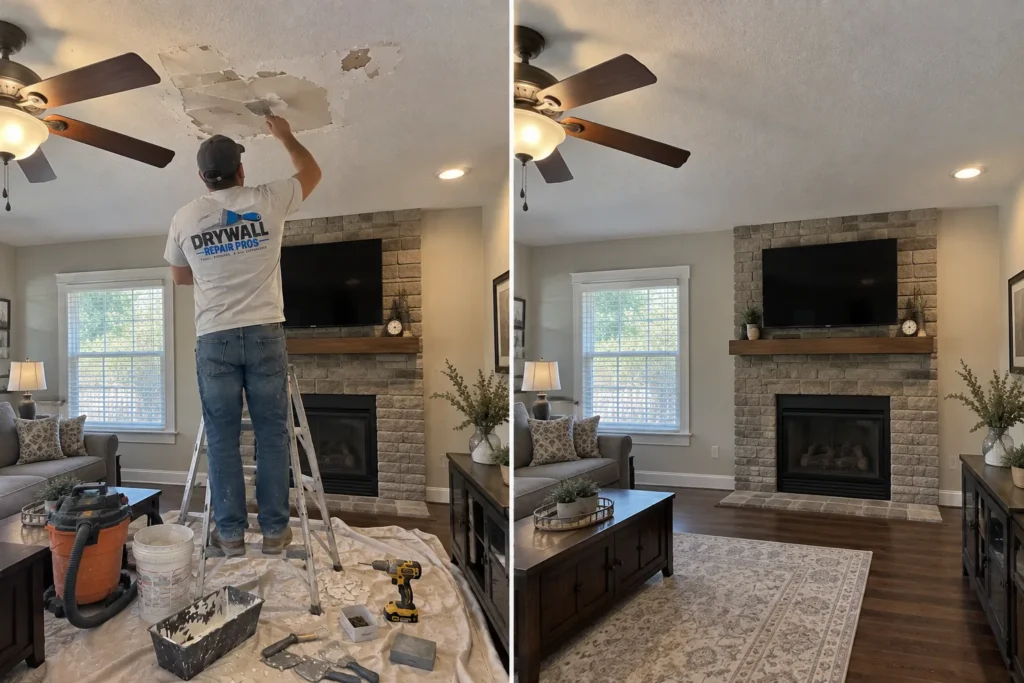
Professional Sagging & Loose Drywall Repair in Cedar Rapids & Iowa City
Drywall should remain firmly attached to the framing behind it. When a wall or ceiling begins sagging, bowing, drooping, separating from framing, or moving when pressed, the problem may involve the panel itself rather than only the finished surface.
Drywall Repair Pros provides professional sagging and loose drywall repair throughout Cedar Rapids, Iowa City, and surrounding communities. We repair and evaluate sagging ceiling drywall, loose wall drywall, drywall pulling away from studs or joists, bowed or drooping panels, drywall sagging between framing members, failed fastening, and previously repaired areas that continue moving.
The correct repair depends on why the drywall lost support, whether the panel remains sound, and whether it can be securely reattached or should be replaced.
Get a Fast Initial Quote From Photos
Many sagging and loose drywall problems can be initially evaluated from clear photos and basic measurements. Send a close-up photo, a wider photo showing the full affected area, approximate width and height, whether the problem is on a wall or ceiling, ceiling height when applicable, and whether the drywall is visibly bowed, drooping, or separated from framing.
Also tell us whether the area moves when lightly pressed, whether nail or screw pops are present, whether there are cracks or seam problems, whether water damage has occurred, whether the condition is getting worse, and whether the surface is smooth, textured, or popcorn.
For ordinary loose drywall, that information is often enough for same-day initial pricing. If a ceiling is heavily sagging, wet, or visibly worsening, do not press on or disturb the area just to gather information. Photograph it from a safe distance and let us know about the condition.
Sagging Drywall vs. Loose Drywall
Sagging Drywall
Sagging drywall has visibly changed shape or position. It may bow downward, curve outward, dip between framing members, develop waves, droop below its original plane, or pull away from fasteners.
Sagging is especially noticeable on ceilings because gravity continuously acts on the panel.
Loose Drywall
Drywall can become loose before obvious sagging appears. Signs may include flexing when pressed, popping or clicking sounds, fastener movement, recurring cracks, moving seams, visible gaps, or repeated nail and screw pops.
Loose drywall should generally be stabilized before cosmetic cracks, seams, tape, or fastener defects are repaired.
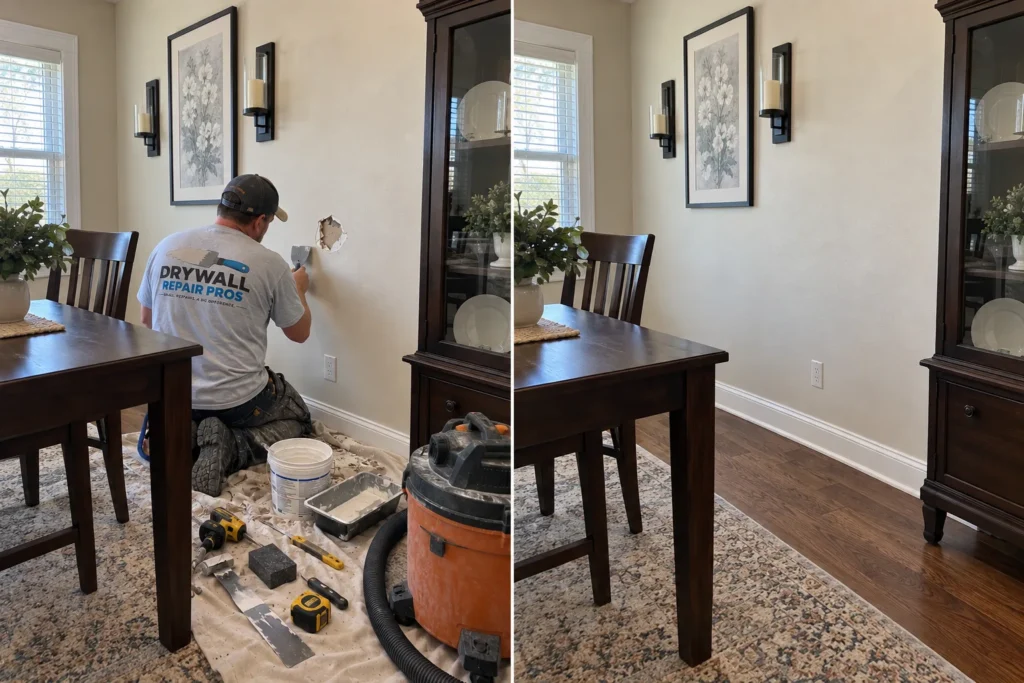
What Causes Drywall to Sag or Come Loose?
Common causes include insufficient fastening, failed or overdriven fasteners, fasteners that missed framing, improper fastener spacing, framing movement, seasonal movement, moisture, water damage, incorrect drywall thickness, excessive spacing between framing members, poor original installation, long-term panel deformation, heavy finishing material, unsupported edges, previous repair problems, and disturbance from remodeling or trade work.
Identifying the cause helps determine whether the drywall can be resecured or whether part of the panel should be removed and replaced.
Sagging & Loose Ceiling Drywall
Sagging Ceiling Drywall
Ceilings are one of the most common places to notice sagging drywall. Signs can include visible dips, waves, drooping areas, seams that no longer align, fastener pops, cracks, movement, or gaps near framing.
The ceiling should be evaluated to determine whether the panel remains sound enough to resecure or whether deformation or damage makes replacement more appropriate.
Loose Ceiling Drywall
Loose ceiling drywall may show only subtle movement at first. Repeated screw pops, nail pops, seam cracks, tape failure, changing shadows, or slight movement can indicate that the panel is no longer held tightly against framing.
The panel may need additional fastening before the visible finish defects are repaired.
Drywall Sagging Between Ceiling Joists
Drywall can sag between joists while still remaining attached at the framing lines. A repeating pattern of dips may develop across the ceiling.
Possible contributors include insufficient panel thickness for the span, wide framing spacing, moisture exposure, heavy finishing material, or long-term deformation. The amount and permanence of the sag help determine whether the panel can be retained.
Drywall Pulling Away From Ceiling Joists
When ceiling drywall begins separating from joists, fasteners may no longer be holding the panel tightly. Gaps, fastener pops, cracks, sagging, movement, and visible seams can appear.
Drywall that remains sound may sometimes be resecured to solid framing. Panels that are badly deformed or weakened may require localized replacement.
Loose Drywall Pulling Away From Studs or Framing
Wall drywall can also loosen from studs. You may notice flexing when pressed, popping noises, repeated screw pops, cracked seams, movement around patches, or visible gaps.
The repair depends on the condition of the drywall, framing location, existing fasteners, amount of movement, moisture history, and whether the panel has permanently changed shape.
Drywall that remains flat, dry, and sound may sometimes be resecured. Weak or badly deformed material may need replacement.
Want Pricing for a Repair Like This?
Most visible repairs can start with photos. Send the property address, a short description, and up to six images.
Signs Drywall Has Lost Support
Common signs include bowing, drooping, flexing, movement when pressed, popping or clicking sounds, waves, gaps, fastener movement, changing shadows, recurring cracks, loose seams, and visible panel separation.
Movement is especially important. Drywall should not move substantially under light pressure. A loose edge, failed fastener, unsupported section, or moving patch should be stabilized before cosmetic finishing.
Loose Drywall Can Cause Other Repairs to Keep Failing
Panel movement can contribute to recurring seam cracks, tape failure, nail and screw pops, corner cracks, and patch failure. If the underlying drywall remains loose, repeatedly repairing the visible defect may only provide temporary improvement.
For problems where the seam, tape, fastener, crack, or patch is the primary concern, see Drywall Seam & Joint Repair, Drywall Tape Repair, Nail Pop & Screw Pop Repair, Drywall Crack Repair, or Drywall Patch Repair.

Sagging Drywall After Water Damage
Water can reduce drywall strength and stiffness. Wet drywall may sag, swell, bow, soften, separate from fasteners, or permanently lose its original shape.
A sagging ceiling after a plumbing or roof leak deserves particular attention because moisture may have collected above the panel or soaked into the gypsum core. Staining, softness, bulging, bubbling paint, cracks, or a changing ceiling shape can indicate more than a cosmetic problem.
The moisture source should be corrected before permanent drywall repair. For broader moisture-related work, see Water-Damaged Drywall Repair, Water-Damaged Ceiling Repair, or Drywall Repair After Roof Leaks.
Loose Drywall After Remodeling or Trade Work
Plumbing, electrical, HVAC, attic, roofing, and remodeling work can disturb walls or ceilings around access openings, fixtures, framing changes, and patches.
Drywall may loosen where it was cut, patched, joined to new material, reinstalled, or disturbed around framing. The panel should be stabilized before the patch or surrounding finish is completed.
If the drywall damage was created during other trade work, see Drywall Repair After Plumbing Work, Drywall Repair After Electrical Work, or Drywall Repair After Remodeling.
Loose or Sagging Drywall Around Patches & Ceiling Openings
Large wall and ceiling patches depend on proper backing and fastening. A poorly supported patch can move, sink, sag, crack, separate from surrounding drywall, or cause tape failure around its edges.
Loose drywall can also appear around attic access openings, recessed lights, electrical boxes, ceiling fixtures, and fan installations where the surrounding panel has been modified.
Drywall should not be relied upon to support a ceiling fan itself. Fan support should be handled independently from the drywall finish and repair.
Sagging Drywall in Bathrooms, Basements & Garages
Bathrooms, basements, garages, and utility areas can expose drywall to humidity, temperature changes, leaks, storage impacts, attic conditions, and older fastening methods.
Moisture-related deterioration should be corrected before drywall is resecured or refinished. The cause matters more than the room name, but these areas commonly reveal sagging or looseness because of their environmental conditions.
Sagging & Loose Drywall in Newer vs. Older Homes
Newer Homes
Newer homes can develop loose drywall because of framing shrinkage, seasonal movement, installation issues, or fastener problems as materials stabilize. Nail or screw pops may appear alongside panel movement.
Older Homes
Older drywall installations may reflect long-term framing movement, older fastening methods, aging materials, previous repairs, or repeated moisture exposure. Repair should account for the existing construction rather than treating only the visible sag.
Can Sagging Drywall Be Screwed Back Up?
Sometimes. Additional fastening may be part of the repair when the drywall is dry, firm, reasonably flat, structurally intact, properly aligned with framing, and still capable of holding fasteners.
Badly bowed, softened, crumbling, or permanently deformed drywall may not return to a flat condition simply by adding screws.
Can Loose Drywall Be Resecured?
Often, yes. If the panel remains intact and sound framing is available, additional properly placed fasteners may secure the drywall again.
After the panel is stabilized, related cracks, seams, fastener damage, and surface defects can be repaired and refinished.
When Does Sagging Drywall Need Replacement?
Replacement becomes more likely when drywall is severely bowed, water damaged, soft, crumbling, broken, permanently deformed, unable to hold fasteners, or no longer capable of returning to the proper plane.
The decision should be based on the condition and strength of the panel, not only on how the finish looks.
Should a Sagging Ceiling Be Repaired Quickly?
A ceiling that is visibly changing shape should be evaluated rather than ignored, especially when the sagging is new, increasing, associated with water, accompanied by cracking, or appearing with multiple fastener failures.
Determining the cause helps establish whether the panel can be safely retained or needs more substantial repair.
Is Sagging Drywall Dangerous?
A small surface irregularity is different from a ceiling panel that has significantly separated from framing. Drywall that is heavily sagging, wet, loose, or visibly worsening can lose additional support.
Avoid disturbing a severely sagging or water-damaged ceiling until its condition is understood. If material appears unstable overhead, keep people and belongings away from the affected area until it can be evaluated.
Does Sagging Drywall Mean There Is a Structural Problem?
Not necessarily. Sagging drywall can result from issues limited to the drywall installation itself, including failed fasteners, improper spacing, moisture, installation problems, or panel deformation.
Framing movement or other building conditions can sometimes contribute, so the pattern and cause should be evaluated rather than assumed.
Repairing Previously Repaired Sagging Drywall
Previous attempts may include extra screws, new tape, compound buildup, spot patches, or texture. If the panel remained loose, those cosmetic repairs may crack or fail again.
A new repair should begin by determining whether the drywall itself is stable and whether the underlying fastening or support problem was corrected.
Why Does My Drywall Keep Coming Loose?
Recurring looseness can result from failed fastening, damaged drywall paper, ongoing framing movement, moisture, insufficient backing, unsupported edges, or an incorrect previous repair.
Additional finishing compound does not stabilize a moving panel. The source of the movement should be addressed first.
Sagging Drywall on Smooth, Textured & Popcorn Ceilings
Smooth ceilings make even slight waves, dips, and framing lines easy to see under directional lighting. After stabilization, finishing may need to extend beyond the immediate repair so the surface transitions more gradually.
Texture can disguise minor surface variation, but it cannot correct loose drywall. The panel should be stabilized or replaced first, then texture restored.
With popcorn ceilings, the texture can make the exact panel shape harder to read. Cracks through the texture, dips, loose areas, fastener pops, or changing shadows may indicate movement underneath. See Ceiling Texture Repair & Matching or Popcorn Ceiling Repair for finish-specific work.
Repair Sagging or Loose Drywall Before Painting or Selling
Paint does not correct a loose or sagging panel. Before painting, the drywall should be stable, properly fastened, repaired, finished, sanded, and textured when applicable.
Sagging ceilings, visible dips, recurring cracks, rows of fastener pops, and failed previous repairs can also draw attention during showings and inspections. Correcting the underlying movement before cosmetic finishing creates a better final result.
Sagging & Loose Drywall Repair for Rental Properties
Rental properties may develop loose drywall after leaks, maintenance access, previous patches, unit remodeling, tenant damage, or long-term wear.
Landlords and property managers can send photos of multiple areas at once, including approximate dimensions, wall or ceiling location, whether the area is moving or sagging, and whether water damage is involved. Ordinary loose-panel problems can often be reviewed remotely for initial pricing.
Commercial Sagging & Loose Drywall Repair
Commercial interiors can develop loose or sagging drywall after tenant improvements, mechanical work, plumbing or electrical access, remodeling, previous repairs, or water leaks.
The panel should be stabilized before cosmetic finishing so cracks, seam failures, or fastener defects are less likely to recur.
Sagging & Loose Drywall Repair in Cedar Rapids
Drywall Repair Pros provides sagging drywall repair, loose drywall repair, sagging ceiling repair, drywall pulling away from ceilings or studs, bowed drywall repair, drywall separating from framing, and ceiling drywall sagging between joists throughout Cedar Rapids and surrounding communities.
Sagging & Loose Drywall Repair in Iowa City
We provide professional sagging and loose drywall repair throughout Iowa City and surrounding communities for homeowners, landlords, property managers, apartments, rentals, and commercial interiors. Common projects include loose wall drywall, sagging ceiling drywall, drywall pulling away from framing, drooping panels, and drywall that moves when pressed.
Our Sagging & Loose Drywall Repair Process
Start With Photos and Condition Details
Send close-up and wider photos, approximate dimensions, wall or ceiling location, ceiling height when applicable, amount of visible sagging or bowing, whether the panel moves, whether fastener pops or cracks are present, moisture history, previous repairs, and whether the surface is smooth, textured, or popcorn.
Identify Why the Panel Is Moving or Sagging. We evaluate fastening, framing location, panel condition, deformation, moisture history, surrounding seams and cracks, and previous repairs.
Determine Whether the Drywall Can Be Resecured. Dry, firm, reasonably flat drywall may sometimes be retained, while soft, badly deformed, or weakened material may need replacement.
Stabilize, Resecure, or Replace the Affected Drywall. The repair addresses the panel itself before cosmetic defects are refinished.
Correct Related Fastener, Seam, and Crack Damage. Once the drywall is stable, damaged fastener areas, seams, cracks, tape, or patch edges are repaired as needed.
Finish and Feather the Repair. Joint compound is applied in controlled layers and blended into the surrounding surface.
Restore Texture and Prepare the Surface. Smooth, textured, or popcorn surfaces are prepared for the appropriate final finish.
Can Sagging Drywall Be Repaired Without Replacing It?
Sometimes. Drywall may be repairable when it remains dry, firm, relatively flat, structurally intact, and capable of holding fasteners.
Replacement becomes more likely when the panel has permanently changed shape, lost strength, softened from moisture, or cannot be securely reattached.
Can Loose Drywall Cause Cracks?
Yes. Panel movement can contribute to seam cracks, tape cracks, corner cracks, nail and screw pops, and patch failure.
Stabilizing the drywall addresses the underlying movement that may be causing repeated surface problems.
Frequently Asked Questions About Sagging & Loose Drywall
Why is my drywall sagging?
Common causes include failed fastening, moisture, poor installation, framing movement, incorrect panel thickness for the span, and long-term panel deformation.
Can sagging drywall be repaired?
Yes, depending on the condition of the panel and the cause of the sagging. Some panels can be resecured, while others need localized replacement.
Can sagging ceiling drywall be screwed back up?
Sometimes. If the drywall remains dry, sound, reasonably flat, and capable of holding fasteners, additional fastening may be part of the repair.
Why is my ceiling drywall sagging between joists?
Possible causes include inadequate drywall thickness for the framing span, wide joist spacing, moisture exposure, heavy finishing material, or long-term deformation.
Why does my drywall move when I press it?
The panel may be loose, inadequately fastened, unsupported at an edge, or affected by a previous repair problem.
Can loose drywall be reattached?
Often, yes, if the panel remains in good condition and sound framing is available.
Why is drywall pulling away from the ceiling?
Fastener failure, framing movement, moisture, improper installation, or panel deformation may contribute.
Why is drywall pulling away from wall studs?
Fasteners may have failed, missed framing, been overdriven, or lost holding strength because the panel moved.
Do nail pops mean my drywall is loose?
Sometimes. Multiple or recurring nail and screw pops can be associated with panel movement, although isolated fastener pops can also occur without widespread looseness.
Can water cause drywall to sag?
Yes. Wet drywall can soften, swell, deform, separate from fasteners, and lose strength.
Should sagging water-damaged drywall be replaced?
Replacement may be necessary when the material has softened, deteriorated, permanently deformed, or lost the ability to hold fasteners securely.
Is sagging ceiling drywall dangerous?
Minor irregularities are different from significantly loose, wet, or worsening panels. A heavily sagging ceiling should be evaluated promptly and should not be disturbed until its condition is understood.
Can sagging drywall be repaired without replacing the whole ceiling?
Often, yes. The appropriate scope depends on how much drywall is affected, the panel condition, framing access, and the cause of the sagging.
Can textured sagging ceilings be repaired?
Yes. The drywall is stabilized or replaced first, then the surrounding texture is restored.
Can sagging or loose drywall repair be quoted from photos?
Often. Clear close-up and wider photos, approximate dimensions, wall or ceiling location, ceiling height, amount of sagging or movement, moisture history, visible cracks or fastener pops, and surface texture can provide enough information for initial pricing. Heavily sagging or wet ceilings may require additional evaluation because concealed damage can change the repair scope.
How much does sagging drywall repair cost?
Cost depends on the size and location of the affected area, ceiling height, panel condition, cause of movement, framing access, moisture damage, texture, and whether the drywall can be resecured or requires replacement. See our Drywall Repair Cost & Pricing Guide for broader pricing information.
Get a Fast Sagging & Loose Drywall Repair Quote
For many loose or sagging drywall problems, you can start the pricing process without waiting for a separate on-site estimate.
For the fastest review, include:
- A close-up photo of the affected drywall
- A wider photo showing the full wall or ceiling area
- Approximate width and height of the affected area
- Ceiling height when applicable
- Whether the drywall is sagging, bowed, drooping, loose, or separating from framing
- Whether the panel moves when lightly pressed, if it is safe to check
- Whether nail or screw pops are present
- Whether cracks, seams, or tape problems are present
- Whether there has been water damage or a leak
- Whether the condition is getting worse
- Whether the area has been repaired before
- Whether the surface is smooth, textured, or popcorn
In many ordinary cases, that information is enough for same-day initial pricing. If a ceiling is heavily sagging, wet, or unstable-looking, photograph it from a safe distance and avoid disturbing the area. Drywall Repair Pros serves Cedar Rapids, Iowa City, and surrounding communities.