
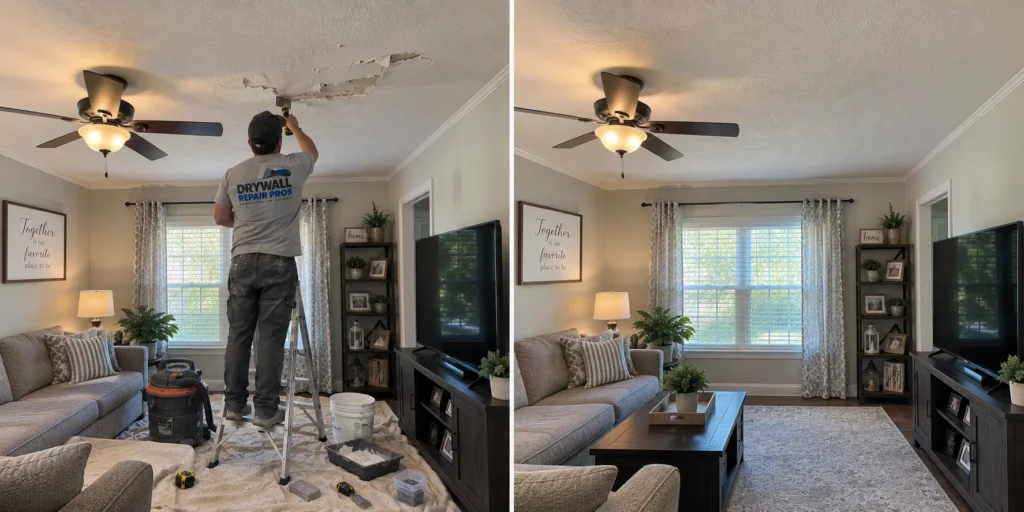
Professional Drywall Patching in Cedar Rapids & Iowa City
A good drywall patch should disappear into the surrounding wall or ceiling. When a patch is poorly supported, built up too heavily with joint compound, improperly taped, or inadequately feathered, the repair itself can become almost as noticeable as the original damage.
Drywall Repair Pros provides professional drywall patch repair and drywall patching for homes, rental properties, apartments, and commercial interiors throughout Cedar Rapids, Iowa City, and surrounding communities.
We repair new localized drywall damage and correct old patches that are cracked, raised, sunken, loose, uneven, visibly outlined, poorly textured, or otherwise difficult to hide. Patching may be appropriate after damage, access openings, removed fixtures, remodeling, trade work, or previous repairs that need to be rebuilt.
The goal is not simply to cover the damaged area. It is to create a stable repair and blend the transition between the patch and the existing drywall as smoothly as practical.
Get a Fast Quote From Photos
Most drywall patch repairs can be evaluated without scheduling a separate in-person estimate. Send a clear close-up photo, a wider photo showing the surrounding wall or ceiling, the approximate width and height of the damaged area, and whether the surface is smooth or textured.
If it is an existing patch, let us know whether it is cracking, raised, sunken, loose, or simply visible after painting. In most cases, that information is enough for us to evaluate the repair and prepare pricing, often the same day.
Drywall Patching for Damaged Walls & Ceilings
Drywall patching is used when a localized portion of a wall or ceiling needs to be restored without unnecessarily replacing a much larger area. Depending on the damage, the repair may involve rebuilding the existing surface or removing an unusable section and installing replacement drywall.
Common reasons for drywall patching include:
- Localized damaged or missing drywall
- Access openings after plumbing, electrical, HVAC, or inspection work
- Removed fixtures, TVs, cabinets, shelving, or wall-mounted equipment
- Remodeling and wall or ceiling alterations
- Accidental damage and previous failed repairs
- Localized water-damaged drywall after the moisture source has been corrected
Patch size matters, but so do drywall thickness, framing location, texture, previous finishing, and the condition of the surrounding surface.
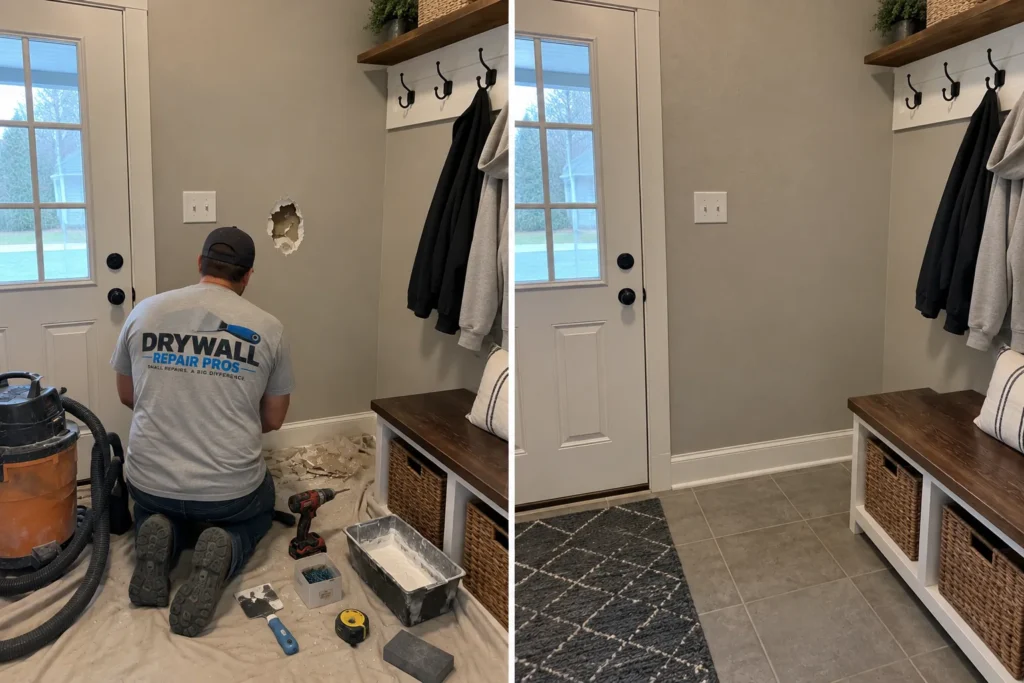
What Is a Drywall Patch?
A drywall patch is a localized repair used to restore a damaged or missing section of drywall. Small surface defects may be repaired without adding replacement material, while larger damaged areas generally need a new piece of drywall that is properly supported and integrated into the existing wall or ceiling.
A successful patch becomes part of the surrounding drywall system. It should not flex like an unsupported insert, sit noticeably above or below the existing surface, or leave a sharp visible outline around the repair.
Wall Patch Repair
Interior walls are the most common location for drywall patches. Wall patch repair may be needed after accidental impacts, fixture removal, electrical or plumbing work, remodeling, cabinet or shelving removal, TV-mount removal, trim changes, or failed previous repairs.
Some patches are only a few inches across. Others involve replacing a larger section between framing members. A larger repair does not automatically require replacing an entire drywall sheet when the surrounding material remains sound.
Ceiling Drywall Patching
Ceiling patches require dependable overhead support and careful finishing because lighting can make uneven transitions especially noticeable. Patching may be needed after plumbing or electrical access, fixture or vent changes, leak investigation, remodeling, water-damaged drywall removal, or previous failed ceiling repairs.
For ceiling-specific openings and larger ceiling patch projects, see our Ceiling Hole & Patch Repair service.
Want Pricing for a Repair Like This?
Most visible repairs can start with photos. Send the property address, a short description, and up to six images.
Sheetrock Patch Repair
Many property owners use Sheetrock and drywall interchangeably when searching for repair services. Sheetrock is a brand name commonly used as a general term for gypsum drywall panels.
Whether you call it drywall patch repair, Sheetrock patch repair, wallboard patching, or a gypsum-board patch, the repair method depends on the size, construction, and condition of the damaged area.
Failed & Visible Drywall Patch Repair
Not every drywall patch starts with new damage. Sometimes the problem is an old repair that never blended correctly or has begun to fail. A previous patch may still be solid but visually obvious, or it may be moving, cracking, or separating from the surrounding drywall.
Cracked Drywall Patches
Cracks around a patch often indicate movement or failure at the repair joint. Possible causes include insufficient backing, loose replacement drywall, failed tape, improper fastening, building movement, or an unstable previous repair. Covering the crack without correcting the failed joint can allow it to return.
For cracking that is not centered on a previous patch, see Drywall Crack Repair.
Visible Patch Outlines
A square or rectangular outline around a drywall patch commonly develops when finishing is concentrated too narrowly around the joint. Thick compound, raised tape, different drywall thickness, uneven sanding, texture differences, paint sheen, and strong side lighting can also make the repair visible.
The transition between the patch and the existing drywall often matters more visually than the center of the patch itself. Proper feathering spreads that transition over a broader area so the change in surface height is less noticeable.
Raised or Bulging Drywall Patches
A raised patch may result from excessive compound, replacement drywall that sits too high, poorly embedded tape, or patch material that is thicker than the surrounding drywall. Simply adding more compound over a raised repair can make the hump larger.
Correction may require reducing excess buildup, rebuilding the underlying patch, or expanding the finished area so the transition becomes more gradual.
Sunken Drywall Patches
A patch can also sit below the surrounding drywall, creating a depression that becomes especially visible after painting. Thin replacement material, weak backing, poor positioning, or movement can all contribute. The cause of the recessed area should be corrected before the surface is refinished.
Loose Drywall Patches
A drywall patch should remain stable when pressure is applied. Movement can lead to cracked joints, failed tape, visible seams, and repeated repair problems. Loose patches may require additional fastening, backing, or replacement before finishing begins.
Patch Tape Failure
Joint tape reinforces the transition between replacement drywall and the surrounding surface. Peeling tape, bubbling, cracking around the perimeter, visible tape edges, or loose compound may indicate that the patch joint has failed. For widespread tape problems beyond a localized patch, see Drywall Tape Repair.
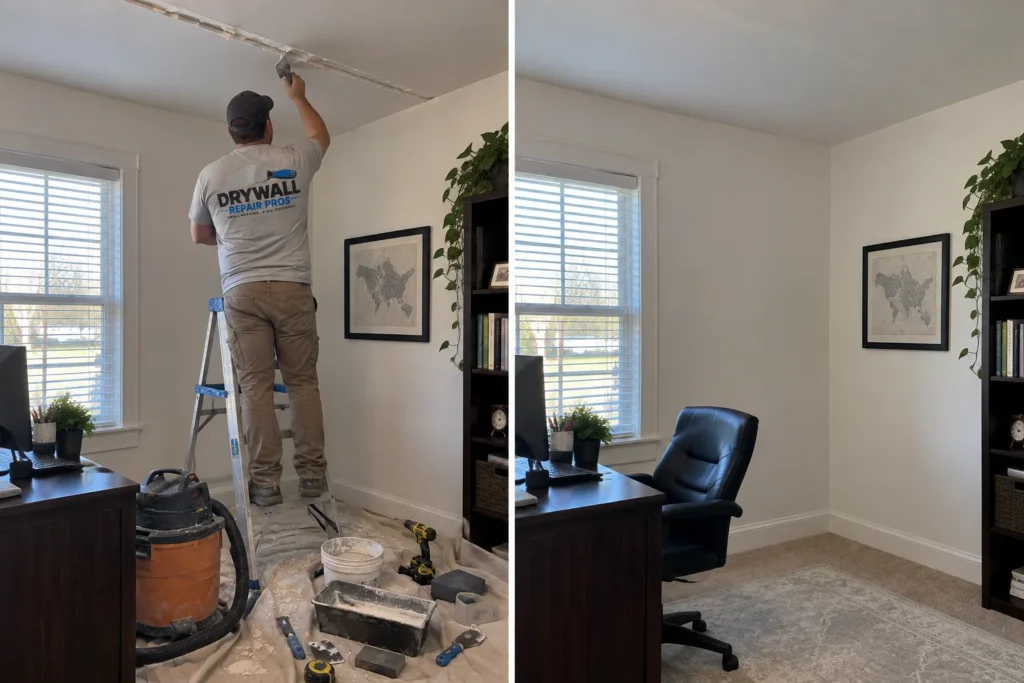
Drywall Patching After Fixtures, Cabinets & Shelving
Removing wall-mounted televisions, shelving systems, cabinets, mirrors, brackets, and other fixtures can leave anchor holes, cable openings, torn drywall paper, crushed gypsum, recessed hardware openings, utility cutouts, and unfinished areas that were previously hidden.
When several defects are concentrated in one area, rebuilding the affected section as one patch can sometimes produce a cleaner result than treating every opening separately. For projects centered primarily on holes rather than patch failure, see Drywall Hole Repair.
Drywall Patching After Remodeling or Trade Work
Renovations and trade work frequently leave localized drywall sections that need to be restored after walls, doors, cabinets, trim, electrical locations, plumbing, or other interior components have been changed.
For projects where renovation itself is the main reason for the drywall work, see Drywall Repair After Remodeling. For access openings created during trade work, see Drywall Repair After Plumbing Work and Drywall Repair After Electrical Work.
Repair Drywall Patches Before Painting or Selling
Paint does not flatten an uneven drywall patch. Differences in height, sanding, texture, compound absorption, and feathering can become more visible after the final coat is applied, especially under strong natural light or lighting that travels across the wall.
Homeowners often repair old patches before interior painting, real estate photos, showings, or listing a home. A poorly finished patch can attract nearly as much attention as the original damage, so correcting the surface before painting usually produces a cleaner final result.
Drywall Patching for Rental Properties
Rental properties often accumulate multiple patch repairs between occupants, including wall-mount damage, anchor holes, old patches, removed fixtures, access openings, and localized wall or ceiling damage.
Landlords and property managers can send photos and approximate dimensions of several repair areas at once. In most cases, we can review the group remotely and provide pricing without scheduling a separate walkthrough, often the same day.
For broader turnover work, see Rental Property & Apartment Drywall Repair.
Commercial Drywall Patching
Commercial spaces change as tenants, equipment, signage, shelving, electrical systems, and room layouts change. We patch localized drywall damage in offices, retail interiors, managed properties, tenant-improvement areas, and other commercial spaces. Multiple patch locations can often be combined into one repair project.
Drywall Patch Repair in Cedar Rapids
Drywall Repair Pros provides drywall patch repair and drywall patching throughout Cedar Rapids and surrounding communities. We repair wall patches, Sheetrock patches, failed previous repairs, visible patch outlines, raised or sunken patches, ceiling patches, and localized damage after fixtures, remodeling, or access work. For broader local services, visit Drywall Repair Cedar Rapids.
Drywall Patch Repair in Iowa City
We also provide professional drywall patching and Sheetrock patch repair throughout Iowa City and surrounding communities for homeowners, rentals, apartments, landlords, property managers, and commercial interiors. For broader local wall and ceiling services, visit Drywall Repair Iowa City.
How Professional Drywall Patching Works
Start With Photos – Usually No Estimate Visit Needed
Send clear close-up and wider photos, the approximate dimensions of each patch or damaged area, whether it is on a wall or ceiling, whether the surface is textured, and whether an old repair is already present. Most patch repairs can be evaluated from that information, and pricing can often be provided the same day.
Evaluate the Damage or Existing Patch. We review the damaged area, surrounding drywall, and any previous repair to determine whether the existing patch can remain or should be rebuilt.
Remove or Stabilize Failed Material. Loose drywall, damaged paper, failed compound, tape, or unstable portions of an old repair are addressed before the new repair is finished.
Prepare and Support the Repair Area. Larger patches receive stable edges, backing, or attachment to existing framing when needed.
Install and Secure Replacement Drywall. Replacement material is fitted and fastened when the damaged section cannot remain.
Tape, Finish, and Feather. Joints are reinforced as needed, compound is applied in appropriate stages, and the repair is extended beyond the patch so the transition becomes gradual.
Prepare the Surface and Restore Texture. The area is smoothed and prepared for its next finish, with texture repair or matching when applicable.
Drywall Patch vs. Replacing an Entire Sheet
Localized damage does not automatically mean an entire drywall sheet needs to be replaced. A patch is often appropriate when the damage is concentrated in one area, the surrounding drywall remains stable, and the repair can be properly supported.
Larger-scale replacement may make more sense when damage is widespread, moisture has compromised a much larger section, or the existing drywall itself is no longer suitable. For a broader discussion, see Repair vs. Replace Drywall.
Why Professional Drywall Patching Matters
Drywall patching can look simple because the materials are familiar. The difficult part is creating a repair that remains stable and does not visually interrupt the wall or ceiling.
A professional patch accounts for support, drywall thickness, joint placement, tape, compound buildup, feathering, sanding, existing texture, lighting, and the condition of the surrounding surface.
The center of the patch is rarely the hardest part. The transition between the new repair and the existing drywall is where the quality of the finished work becomes most noticeable.
Frequently Asked Questions About Drywall Patch Repair
What is drywall patching?
Drywall patching is the repair of a localized damaged or missing section of drywall without necessarily replacing an entire wall, ceiling, or drywall sheet.
Can a large section of drywall be patched?
Yes. Larger sections can often be repaired with replacement drywall when the new material can be properly supported and integrated into the surrounding surface.
Can you repair an old or bad drywall patch?
Yes. A poor or failed patch can often be corrected. Depending on its condition, the existing repair may be refinished, reinforced, partially removed, or rebuilt.
Why is my drywall patch cracking?
Cracking can result from movement, weak support, failed tape, inadequate fastening, or problems with the original joint or repair.
Why can I see the outline of my drywall patch?
Visible outlines commonly result from narrow feathering, raised joints, uneven sanding, texture differences, compound buildup, or differences in surface height.
Can raised and sunken drywall patches be fixed?
Often, yes. The repair method depends on whether the problem comes from compound buildup, drywall thickness, patch position, weak support, or movement.
Does a drywall patch need backing?
Larger patches often need backing or attachment to framing so the replacement drywall remains stable.
Does drywall patching require tape?
Many replacement patches require joint tape to reinforce their seams. Very small surface repairs may use a different method.
Can ceiling drywall be patched?
Yes. Ceiling drywall can be patched, although overhead support, lighting, and texture can make the repair more demanding.
Can Sheetrock be patched?
Yes. Sheetrock is a commonly used brand name for drywall, and localized Sheetrock damage can usually be repaired using the same patching principles.
Can several drywall areas be patched during one project?
Yes. Multiple repair areas can often be handled together, which is common during rental turnover, remodeling, pre-sale preparation, and whole-house painting projects.
Can drywall patch repair be quoted from photos?
In most cases, yes. Send close-up and wider photos, approximate dimensions, wall or ceiling location, whether the repair is new or existing, and whether the surface is textured. Most patch projects can be evaluated without a separate estimate visit, and pricing can often be provided the same day.
How much does drywall patch repair cost?
Pricing depends on the size and number of patches, wall versus ceiling location, accessibility, texture, drywall thickness, condition of previous repairs, and the finishing required. See our Drywall Repair Cost & Pricing Guide for broader pricing information.
Get a Fast Drywall Patch Repair Quote
You usually do not need to schedule an in-person estimate just to find out what a drywall patch repair will cost. Upload a few clear photos and basic information about the repair area.
For the fastest review, include:
- A close-up photo of each damaged area or existing patch
- A wider photo showing its location on the wall or ceiling
- Approximate width and height
- Whether the patch is new damage or a previous repair
- Whether it is cracked, raised, sunken, loose, or visibly outlined
- Whether the surrounding surface is smooth or textured
- The total number of areas you want repaired
For most drywall patch repairs, that is enough information for us to evaluate the project and prepare a quote. In many cases, pricing can be provided the same day.
Drywall Repair Pros serves Cedar Rapids, Iowa City, and surrounding communities. Upload your photos and project details to request your free drywall patch repair quote.