
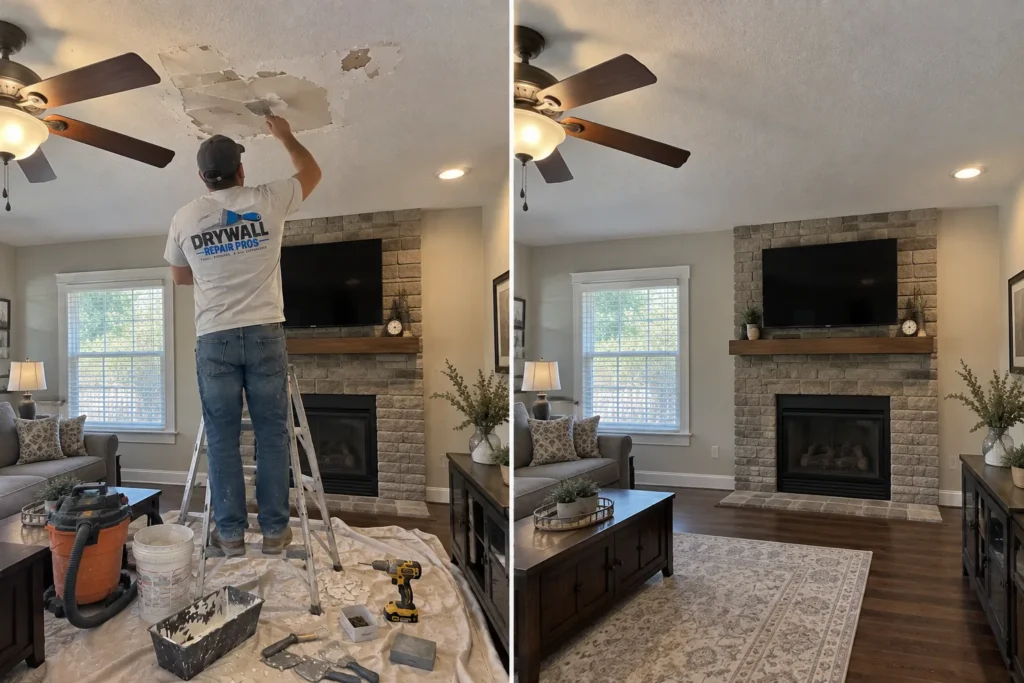
Professional Drywall Nail Pop & Screw Pop Repair in Cedar Rapids & Iowa City
Small round bumps, circles, cracks, or exposed fastener heads in drywall are often caused by movement at the fastener or in the drywall panel itself. These defects are commonly called nail pops or screw pops.
Drywall Repair Pros provides professional nail pop and screw pop repair for walls and ceilings throughout Cedar Rapids, Iowa City, and surrounding communities. We repair isolated and recurring fastener pops, visible nail or screw heads, cracked compound around fasteners, rows of pops along framing, and fastener problems around seams, patches, and previous repairs.
A lasting repair should address movement at the fastener or drywall panel instead of simply covering the visible spot.
Get a Fast Nail Pop or Screw Pop Quote From Photos
Nail and screw pops are usually easy to evaluate from clear photos. Send a close-up of the defect, a wider photo showing its location, tell us whether it is on a wall or ceiling, and provide an approximate count.
Also note whether the pops appear in a straight line or pattern, whether the drywall moves when pressed, whether there are nearby cracks, whether the area has been repaired before, and whether the surface is smooth or textured. In many cases, we can provide same-day initial pricing without scheduling a separate estimate visit.
Drywall Nail Pop Repair
A nail pop occurs when a drywall nail or the panel around it moves enough to disturb the compound above the fastener. It may appear as a small round bump, circular crack, raised spot, shallow crater, exposed nail head, or loose compound.
The nail does not always literally push out of the wall. Even slight movement can break the finish and make the fastener location visible.
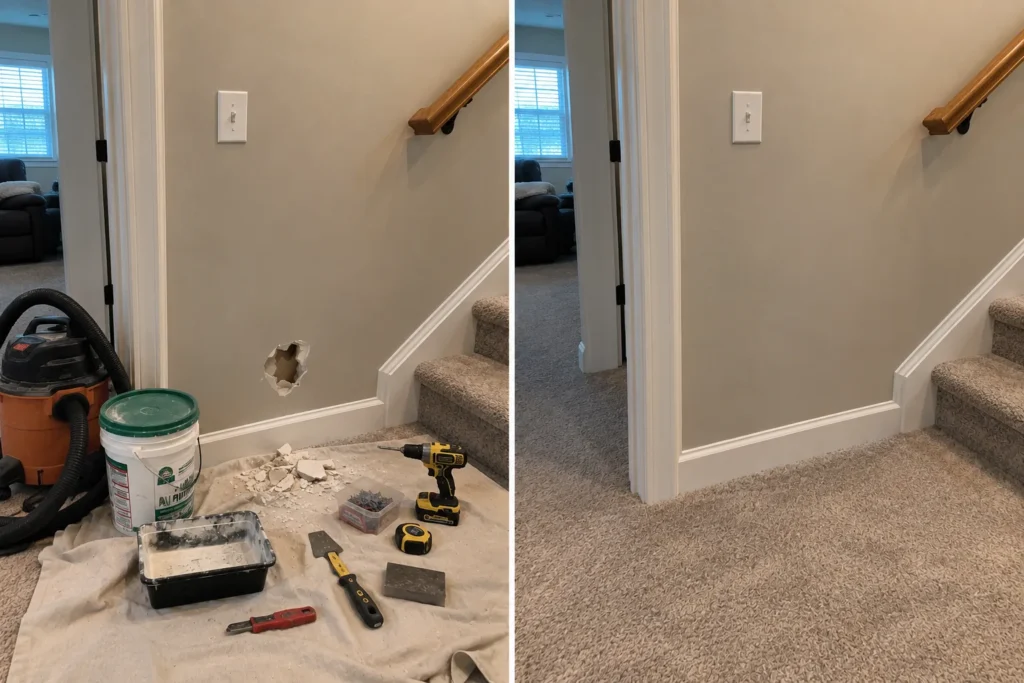
Drywall Screw Pop Repair
Screw pops look similar to nail pops but can develop for slightly different reasons. A screw may have been driven too deep, torn through the drywall face paper, lost holding strength, missed solid framing, or become ineffective because the panel moved.
A loose or poorly seated screw should not simply be covered with compound. The drywall may need to be secured before the surface is refinished.
Why Do Nail & Screw Pops Happen?
Common causes include framing shrinkage, seasonal movement, temperature and humidity changes, minor building settlement, loose drywall, improper fastening, fasteners that missed framing, nails backing out slightly, overdriven screws, torn drywall paper, panel movement, and previous repair failure.
Fastener pops can occur in both newer and older homes. The important question is whether the problem is an isolated cosmetic defect or part of a larger movement pattern.
Nail & Screw Pops in Walls
Wall fastener pops may appear individually or in groups on partition walls, exterior-facing walls, stairwells, hallways, bedrooms, living areas, basements, garages, and other finished spaces.
Repeated defects along the same stud line can indicate that the drywall has moved along one framing member. The panel should be checked for movement before cosmetic finishing.
Want Pricing for a Repair Like This?
Most visible repairs can start with photos. Send the property address, a short description, and up to six images.
Nail & Screw Pops in Ceilings
Ceiling nail and screw pops can be especially noticeable because overhead and side lighting highlights small raised circles and cracks. They may result from framing movement, truss movement, seasonal expansion and contraction, loose drywall, or original fastening problems.
If the ceiling is sagging, noticeably loose, or moving beyond isolated fastener spots, broader repair may be needed. See Sagging & Loose Drywall Repair or Ceiling Drywall Repair for those conditions.
Fastener Pops Near Drywall Seams & Joints
Nail and screw pops often appear near drywall seams because joints and nearby framing can experience movement. The fastener problem may occur with cracking, raised compound, loose tape, or joint movement.
Nail Pops Near Doors & Windows
Doors and windows are common areas for concentrated framing movement. Fastener pops may show above headers, beside frames, near corners, or along nearby drywall joints.
The surrounding drywall should be checked for cracking, movement, or previous repair failure before the fastener spots are refinished.
Nail Pops in Newer vs. Older Homes
Newer Homes
In newer construction, framing lumber can dry and shrink as moisture levels stabilize. Small changes in the framing can move nails or drywall enough to crack the finish over a fastener. A few isolated pops may be cosmetic, while larger patterns deserve closer evaluation.
Older Homes
Older homes may develop fastener pops from long-term framing movement, seasonal changes, loose drywall, older fastening methods, previous repairs, or repeated cycles of expansion and contraction.
The repair may require adding properly placed fasteners around the affected area rather than simply resetting an old nail.
Nail & Screw Pops After Remodeling or Other Work
Remodeling and trade work can disturb framing or finished drywall and sometimes contribute to new fastener pops. Examples include wall removal, new walls, ceiling work, attic or roof-framing work, plumbing access, electrical work, cabinet removal, door or window changes, vibration, and installation of new patches.
When the broader project is the main reason for the drywall repair, see Drywall Repair After Remodeling, Drywall Repair After Plumbing Work, or Drywall Repair After Electrical Work.
Fastener Pops After Water Damage
Moisture can soften drywall, weaken the face paper around fasteners, and contribute to movement. If fastener pops appear with staining, softness, loose tape, swelling, or sagging, the moisture source should be corrected and the drywall should be evaluated before cosmetic repair.
For broader moisture damage, see Water-Damaged Drywall Repair or Water-Damaged Ceiling Repair.
Why Do Nail & Screw Pops Keep Coming Back?
Recurring fastener pops usually mean the underlying movement or fastening problem was not fully corrected. Common reasons include loose drywall, framing movement, inadequate fastening, reusing a loose nail, an overdriven screw, damaged face paper, or continued movement in the surrounding panel.
Adding more compound over the same unstable fastener may hide the spot temporarily without correcting the reason it keeps returning.
Why Are My Nail Pops Appearing in a Straight Line?
A line of nail or screw pops can follow a wall stud, ceiling joist, or other framing member. This pattern can show that the issue is not isolated to one fastener but involves panel movement along the same framing line.
The repair may require securing the drywall at multiple points before the visible fastener spots are refinished.
Nail Pops With Other Drywall Problems
Fastener pops sometimes appear with previous patches, drywall cracks, failed seams, loose drywall, or other movement-related defects. The surrounding condition helps determine which problem should be treated as the primary repair.
For patch-specific problems, see Drywall Patch Repair or Ceiling Hole & Patch Repair. For crack-dominant problems, see Drywall Crack Repair or Ceiling Crack Repair. For loose or sagging panels, see Sagging & Loose Drywall Repair.
Fastener Pop Repair on Smooth & Textured Surfaces
Smooth Walls & Ceilings
Smooth surfaces make even small fastener repairs easier to see. Compound thickness, feathering, sanding, surface flatness, and lighting all affect whether the finished spot blends into the surrounding wall or ceiling.
Textured & Popcorn Surfaces
Textured walls and ceilings need the fastener problem stabilized first, followed by surface repair and texture restoration. Popcorn ceilings may require localized texture removal and replacement around the repaired fastener.
For texture-focused work, see Drywall Texture Repair & Matching, Ceiling Texture Repair & Matching, or Popcorn Ceiling Repair.
Repair Nail Pops Before Painting or Selling
Nail and screw pops should generally be repaired before final painting. Paint will not secure loose drywall, stop fastener movement, flatten raised compound, or prevent recurring pops.
Rows of visible circles, cracked fastener spots, and previous repairs showing through paint can also stand out in listing photography or home showings. Stabilizing and refinishing the fastener areas first creates a better surface for paint.
Nail Pop Repair for Rental Properties
Rental properties may develop nail and screw pops from normal movement, building age, previous repairs, tenant damage, remodeling, or turnover work.
Landlords and property managers can send photos of multiple fastener pops at once. A few wider room photos plus close-ups, approximate counts, wall or ceiling location, and any visible pattern usually provide enough information for initial pricing.
Commercial Nail Pop & Screw Pop Repair
Commercial interiors can develop fastener pops after tenant improvements, remodeling, mechanical work, building movement, or previous repairs. Repeated fastener defects can be especially noticeable in offices, retail spaces, hallways, and other finished areas with bright lighting.
Nail Pop & Screw Pop Repair in Cedar Rapids
Drywall Repair Pros provides professional drywall nail pop repair, screw pop repair, ceiling nail pop repair, wall fastener repair, recurring nail pop repair, and visible drywall fastener repair throughout Cedar Rapids and surrounding communities.
Nail Pop & Screw Pop Repair in Iowa City
We provide drywall nail pop and screw pop repair throughout Iowa City and surrounding communities for homeowners, landlords, property managers, apartments, rentals, and commercial interiors. Common projects include ceiling pops, wall screw pops, fastener heads showing through drywall, recurring pops, and rows of fastener defects along framing.
Our Nail Pop & Screw Pop Repair Process
Start With Photos and Fastener Details
Send close-up and wider photos, the approximate number of pops, whether they are on walls or ceilings, whether they form a line or pattern, whether nearby drywall moves when pressed, whether cracks are present, whether the area has been repaired before, and whether the surface is smooth or textured.
Check the Drywall for Movement and Patterns. We evaluate whether the fastener defect is isolated or part of a larger framing or panel-movement pattern.
Secure Loose Drywall. Additional properly placed fasteners may be installed when the panel needs better support.
Correct or Supplement Failed Fasteners. Loose, raised, overdriven, or ineffective fasteners are addressed as appropriate.
Remove Loose Finishing Material. Cracked or unstable compound around the fastener is removed before rebuilding the surface.
Refinish and Feather the Repair. The fastener spots are filled, blended, and sanded so they transition into the surrounding drywall.
Restore Texture and Prepare for Paint. Texture is restored when applicable and the repaired areas are prepared for the next finish.
Should a Nail Pop Just Be Hammered Back In?
Usually, simply hammering the same nail back into place is not the best long-term repair. If the drywall has moved or the nail has loosened, the area may need additional fastening so the panel is stabilized rather than merely hidden.
Should a Screw Pop Just Be Tightened?
Not always. If a screw has already torn the drywall face paper or lost holding strength, driving it deeper can make the problem worse. A properly placed fastener nearby may be a better solution.
Can Nail Pops Be Permanently Repaired?
Often, yes. A durable repair is more likely when the drywall is secured, ineffective fasteners are corrected, new fasteners are installed properly, movement is limited, and the surface is refinished correctly.
If framing movement continues, additional pops can sometimes develop elsewhere even after the original repair is completed.
Do Nail Pops Mean There Is a Structural Problem?
Usually not. Most nail and screw pops are related to framing movement, drywall movement, fastening issues, or normal seasonal changes rather than a major structural problem.
Widespread new fastener pops accompanied by major cracking, significant sagging, or obvious building movement may warrant additional evaluation before cosmetic repair.
Frequently Asked Questions About Nail Pops & Screw Pops
What is a drywall nail pop?
A nail pop is a small raised, cracked, or visible fastener area caused by movement of a drywall nail or the panel around it.
What is a drywall screw pop?
A screw pop is a similar defect involving a drywall screw beneath the finished surface.
Why are nails popping through my drywall?
Common causes include framing shrinkage, seasonal movement, loose drywall, panel movement, and fastening problems.
Can nail pops be repaired?
Yes. A durable repair usually starts by checking and stabilizing the drywall before the visible defect is refinished.
Can screw pops be repaired?
Yes. The failed fastener area can be corrected, the panel can be secured if necessary, and the surface can be refinished.
Why do nail pops keep coming back?
Recurring pops usually indicate that movement, loose drywall, or the fastening problem was not fully corrected during the previous repair.
Why are there nail pops in my ceiling?
Ceiling pops may result from framing movement, truss movement, loose drywall, seasonal changes, or original fastening issues.
Are ceiling nail pops dangerous?
Most are cosmetic. Multiple new pops combined with sagging, significant cracking, or noticeable ceiling movement should be evaluated more closely.
Can nail pops happen in new homes?
Yes. Framing shrinkage and moisture changes can cause fastener movement as new construction materials stabilize.
Can nail pops happen in older homes?
Yes. Long-term movement, previous repairs, seasonal changes, and older fastening methods can all contribute.
Do nail pops need new screws?
Sometimes. Properly placed screws can help secure loose drywall when the existing fastener no longer provides reliable support.
Can nail pops in textured drywall be repaired?
Yes. The fastener repair is completed first, then the surrounding texture is restored.
Should nail pops be repaired before painting?
Yes. Painting alone does not correct movement or loose fastening beneath the surface.
Can nail pop and screw pop repair be quoted from photos?
Usually. Clear close-up and wider photos, an approximate count, wall or ceiling location, visible patterns, nearby cracks, previous repair history, and surface texture can often provide enough information for initial pricing.
How much does nail pop repair cost?
Cost depends on the number of fasteners, wall versus ceiling location, accessibility, drywall movement, texture, previous repairs, whether the defects form a pattern, and whether multiple areas are involved. See our Drywall Repair Cost & Pricing Guide for broader pricing information.
Get a Fast Nail Pop & Screw Pop Repair Quote
Most nail and screw pop projects can be reviewed without a separate on-site estimate. Send clear photos and basic project details so we can see the fastener pattern and surrounding drywall.
For the fastest review, include:
- A close-up photo of several representative pops
- A wider photo showing where they are located
- Whether the pops are on walls, ceilings, or both
- Approximate number of visible pops
- Whether they appear in a line or pattern
- Whether the drywall moves when pressed
- Whether there are nearby cracks, loose seams, or sagging
- Whether the area has been repaired before
- Whether the surface is smooth, textured, or popcorn
- Whether there has been recent remodeling, trade work, or water damage
In many cases, that information is enough for same-day initial pricing. Drywall Repair Pros serves Cedar Rapids, Iowa City, and surrounding communities.