
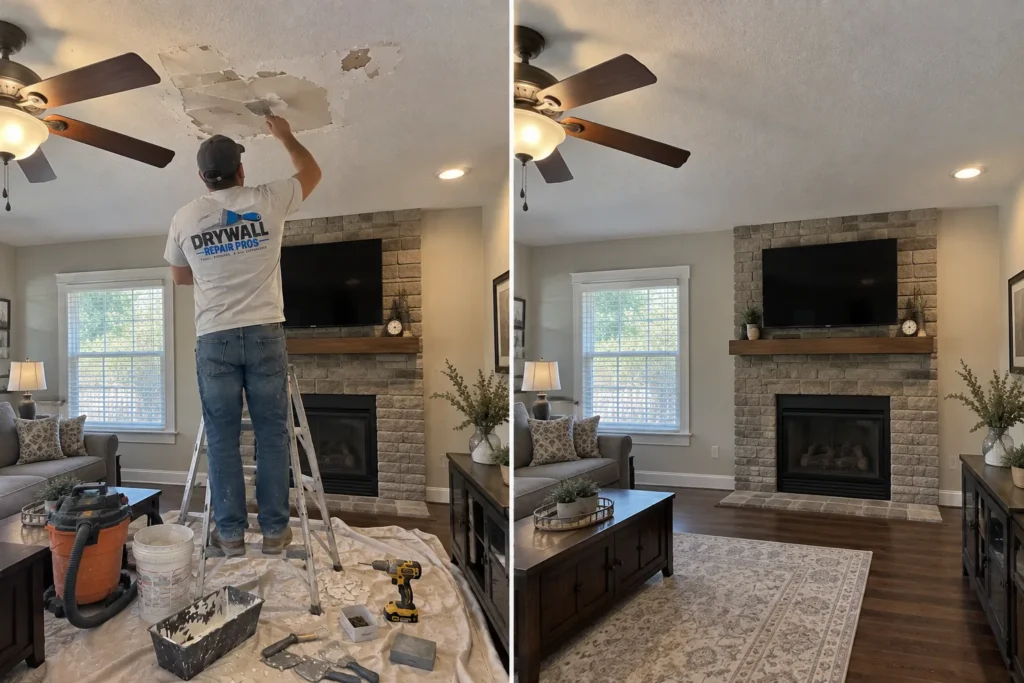
Professional Water-Damaged Ceiling Repair in Cedar Rapids & Iowa City
Water damage in a ceiling can spread farther than the visible stain. A roof leak, plumbing leak, overflowing fixture, HVAC problem, appliance failure, or hidden moisture source can affect drywall above, around, and beyond the first visible mark.
Drywall Repair Pros provides professional water-damaged ceiling repair for homes, rental properties, apartments, and commercial interiors throughout Cedar Rapids, Iowa City, and surrounding communities.
We repair ceiling drywall affected by leaks, stains, soft or swollen material, sagging, bubbling or peeling finishes, failed tape, damaged seams, previous water-damage patches, and localized areas where compromised drywall has already been removed.
The water source should be corrected before final ceiling repair. Once the area is appropriately dry, the damaged drywall can be evaluated to determine what can remain and what should be removed or replaced.
Get a Fast Water-Damaged Ceiling Repair Quote From Photos
Once the water source has been corrected, send a close-up photo, a wider room photo, approximate damage dimensions, ceiling height, whether the ceiling is soft or sagging, whether any drywall has already been removed, and whether the ceiling is smooth, textured, or popcorn.
We can often provide same-day initial pricing from that information without scheduling a separate estimate visit. Water damage can extend beyond what is visible, so the final scope may change if concealed deterioration is discovered after the affected area is opened.
Ceiling Water Damage Repair
Water can affect ceiling drywall in several ways. A small leak may leave only staining, while longer or heavier exposure can weaken the gypsum core, separate the paper facing, loosen tape, soften joint compound, distort the surface, and reduce the ceiling's ability to hold fasteners securely.
The appropriate repair depends on how much water reached the ceiling, how long the material remained wet, whether the source is repaired, whether the area is dry, and whether the drywall is still firm, flat, and stable.
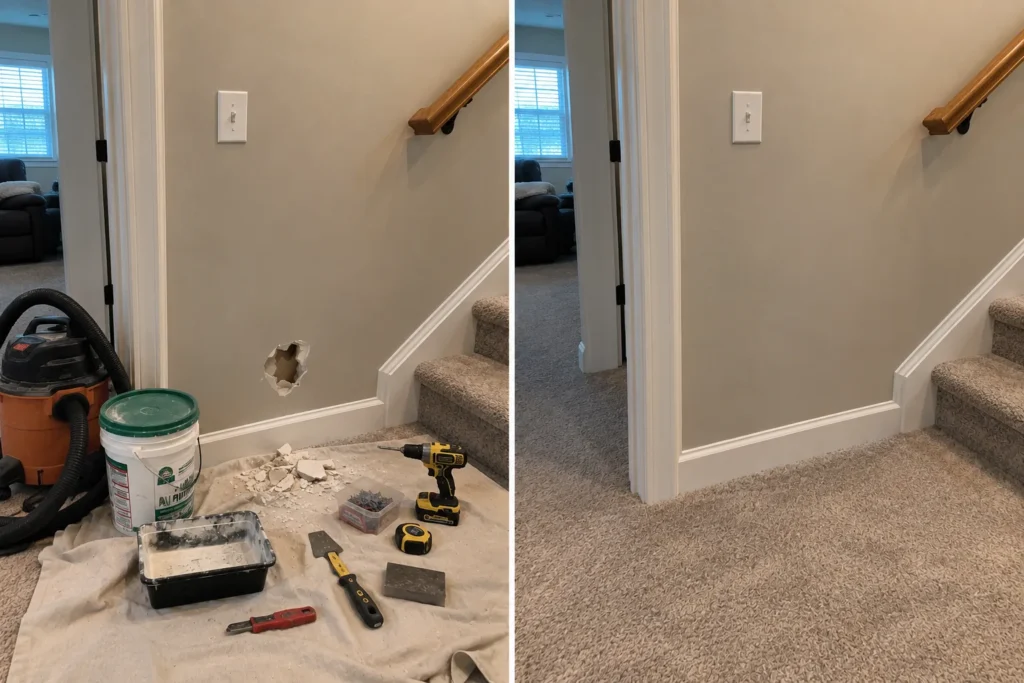
Signs Your Ceiling Drywall Has Water Damage
Common signs include:
- Brown or yellow stains
- Dark rings or discoloration
- Bubbling or peeling paint
- Soft drywall
- Swollen or bulging drywall
- Sagging
- Loose or wrinkled tape
- Cracked or raised seams
- Separated drywall paper
- Crumbling gypsum
- Musty odors
- Previous patch failure
The visible stain does not always show the full extent of the damage because water can travel along framing or within a floor or ceiling cavity before reaching the drywall.
What Causes Water Damage in Drywall Ceilings?
Common causes include roof leaks, plumbing leaks, burst pipes, tub or shower leaks, toilet overflows, drain-line failures, supply-line failures, appliance leaks, water-heater leaks, HVAC condensation, condensate-drain problems, upper-floor plumbing, and weather-related roof intrusion.
The repair sequence is similar regardless of the source: correct the moisture problem first, allow the area to dry appropriately, then evaluate the drywall and repair only what is stable enough to remain.
Water-Stained, Soft, Swollen & Sagging Ceiling Drywall
Water-Stained Ceiling Repair
A ceiling stain does not automatically mean the drywall must be replaced. If the material remains firm, dry, flat, structurally sound, and free of swelling, sagging, or paper separation, the repair may be limited.
The condition of the drywall matters more than the size or color of the stain.
Soft Ceiling Drywall
Soft drywall usually indicates that water has affected the gypsum core. If the material has lost strength, it may no longer hold fasteners reliably and localized replacement may be necessary.
Soft ceiling drywall should not simply be covered with joint compound.
Swollen or Bulging Ceiling Drywall
Moisture can cause drywall to swell, bow, or permanently distort. Signs may include raised seams, wavy areas, bulges, cracked compound, or loose tape. Material that remains deformed after drying may be better addressed with localized replacement.
Sagging Ceiling After Water Damage
Sagging is more serious than staining alone. Saturated drywall can soften, lose fastener-holding strength, separate at the paper facing, and become heavier.
Avoid disturbing or standing directly beneath a badly sagging or heavily saturated section until its condition has been evaluated. A sagging area should not be treated as a surface-only repair.
Want Pricing for a Repair Like This?
Most visible repairs can start with photos. Send the property address, a short description, and up to six images.
Water-Damaged Ceiling Seams & Tape
Moisture can soften joint compound and cause drywall tape to bubble, peel, wrinkle, loosen, or separate. Ceiling seams may also become cracked, raised, discolored, or visibly distorted.
The joint should be repaired only after the area is dry and stable. Failed tape may need removal and replacement rather than being buried under more compound. For broader issues, see Drywall Tape Repair or Drywall Seam & Joint Repair.
Ceiling Water Damage From Plumbing & Upper-Floor Leaks
Plumbing leaks are a common source of ceiling damage in multi-level homes and buildings. Water may come from supply lines, drain lines, toilets, sinks, showers, bathtubs, valves, hidden piping, or burst pipes.
Leaks from an upstairs bathroom can spread beyond the area directly below the fixture. Once the plumbing problem is corrected and the cavity is appropriately dry, the ceiling should be checked for staining, softness, swelling, sagging, loose tape, failed seams, and damaged drywall.
For trade-specific post-plumbing repairs, see Drywall Repair After Plumbing Work.
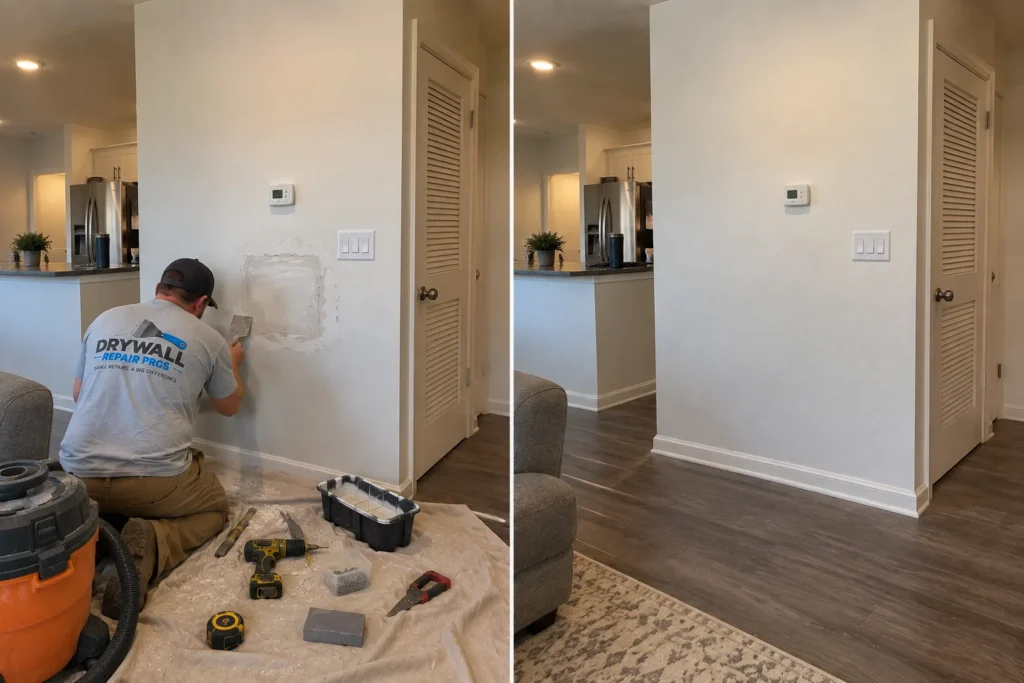
Ceiling Water Damage From Roof Leaks & Storms
Roof leaks often first appear as ceiling stains, but the visible mark may be some distance from the actual roof entry point. Brown rings, yellow discoloration, bubbling paint, soft spots, cracked seams, loose tape, and sagging can all occur.
The roofing or exterior source should be corrected before drywall repair begins. For roof-specific drywall damage, see Drywall Repair After Roof Leaks.
Ceiling Water Damage From HVAC, Appliances & Other Sources
HVAC condensation, condensate-drain failures, washing machines, dishwashers, refrigerators, ice makers, and water heaters can all cause ceiling water damage when they are located above finished space.
Once the source is repaired and the area is appropriately dry, the ceiling drywall can be evaluated for whether localized repair or replacement is more appropriate.
Does Water-Damaged Ceiling Drywall Need to Be Replaced?
Not every stained or previously wet ceiling needs drywall replacement.
The Ceiling May Be Repairable When
- The drywall is fully dry
- The material remains firm
- There is no sagging
- The paper remains bonded
- The surface is still flat
- Damage is superficial and localized
- The panel can still be securely retained
Replacement Is More Likely When
- Drywall is soft
- The ceiling is sagging
- The material is swollen or permanently distorted
- Gypsum is crumbling
- Paper has separated
- The area was heavily saturated
- The drywall cannot hold fasteners securely
- Damage is widespread or unstable
Localized replacement is often enough when the surrounding ceiling remains sound. For broader repair-versus-replacement guidance, see Repair vs. Replace Drywall.
Water-Damaged Sheetrock Ceiling Repair
Homeowners often use Sheetrock as another term for drywall. Water-damaged Sheetrock ceilings, wet Sheetrock ceiling repair, and Sheetrock ceiling repair after a leak follow the same repair principles: correct the source, allow the area to dry, evaluate the material, and replace only the sections that are no longer suitable to remain.
Ceiling Repair After Leak Investigation
Sometimes part of a ceiling is opened to locate a hidden plumbing or roof leak. After the source is repaired and the area is dry, the access opening may require backing, replacement drywall, fastening, taping, finishing, feathering, and texture restoration.
For opening-specific work, see Ceiling Hole & Patch Repair.
Repairing a Previous Water-Damaged Ceiling Patch
Old water-damage repairs can fail later. Common problems include cracks around the patch, raised or sunken outlines, loose tape, uneven compound, texture mismatch, recurring staining, or a patch that moves.
A stable patch may only need refinishing. A loose or damaged patch may need to be rebuilt before the surface is restored.
Water-Damaged Ceilings Throughout the Home
Water-damaged ceiling drywall can occur in nearly any finished area. Bathrooms and rooms below bathrooms are frequent trouble spots because of plumbing and overflows. Kitchens may be affected by plumbing or appliance leaks. Basement ceilings are often exposed to plumbing from the floor above. Garages may be affected by roof leaks, plumbing, bathrooms, HVAC systems, or other water intrusion.
The room location helps identify likely sources, but the repair decision should still be based on the condition of the drywall itself.
Repair Water-Damaged Ceilings Before Painting or Selling
Water-damaged ceilings should be repaired before final painting. Painting over active moisture, soft drywall, failed tape, swelling, or sagging does not solve the underlying problem.
Visible stains, old leak marks, cracks, sagging, loose tape, previous patches, and texture differences can also raise immediate concerns during home showings. The moisture source should be corrected and the visible ceiling damage properly repaired before final finishing or listing photography.
Water-Damaged Ceiling Repair for Rental Properties
Rental properties may experience ceiling water damage from plumbing leaks, tenant overflows, appliance failures, roof leaks, maintenance problems, or leaks from upper units.
Landlords and property managers can send photos of multiple affected areas together with approximate dimensions, ceiling height, whether the leak is repaired, whether the area is dry, and whether any drywall has already been removed. We can often provide initial pricing remotely, while reserving final scope adjustments for concealed damage that becomes visible during repair.
Commercial Water-Damaged Ceiling Repair
Commercial buildings may develop ceiling water damage from roof leaks, plumbing failures, HVAC systems, sprinkler leaks, mechanical failures, or tenant improvements. Localized ceiling drywall damage can often be repaired after the source is corrected and the affected area is dry.
Water-Damaged Ceiling Repair in Cedar Rapids
Drywall Repair Pros provides water-damaged ceiling repair throughout Cedar Rapids and surrounding communities. Common projects include ceiling water damage repair, wet ceiling drywall repair, water-stained ceilings, soft ceiling drywall, sagging ceilings after leaks, ceiling repair after plumbing or roof leaks, wet Sheetrock ceiling repair, and ceiling damage after burst pipes.
Water-Damaged Ceiling Repair in Iowa City
We provide water-damaged ceiling repair throughout Iowa City and surrounding communities for homeowners, landlords, property managers, rental properties, apartments, and commercial interiors. Services include wet drywall ceiling repair, water-stained ceiling repair, soft or sagging ceiling drywall, ceiling repair after leaks, wet Sheetrock ceiling repair, and plumbing-leak ceiling repair.
Our Water-Damaged Ceiling Repair Process
Start With Photos and Moisture Details
Send a close-up photo, a wider room photo, approximate damage dimensions, ceiling height, whether the ceiling is soft or sagging, whether drywall has already been removed, whether the area is dry, what caused the damage if known, and whether the ceiling is smooth, textured, or popcorn.
Confirm the Water Source Is Corrected and the Area Is Dry. Final drywall repair should not begin while active moisture is still affecting the ceiling.
Evaluate the Visible Damage. We review staining, softness, swelling, sagging, paper separation, joint failure, tape failure, and previous repairs.
Determine What Drywall Can Remain. Sound, stable material may stay in place; compromised or unstable drywall should be removed.
Remove Damaged Material and Install Supported Replacement Drywall. Replacement sections are fitted and securely supported where needed.
Tape, Finish, and Feather the Repair. New joints are integrated into the surrounding ceiling with controlled compound buildup and broad transitions.
Restore Texture and Prepare the Surface. Smooth, textured, or popcorn ceilings are prepared for the appropriate final finish.
Frequently Asked Questions About Water-Damaged Ceilings
Can water-damaged ceiling drywall be repaired?
Yes. The repair depends on whether the drywall remains structurally sound after the moisture source is corrected and the area dries.
Does wet ceiling drywall always need to be replaced?
No. Firm, fully dried drywall may sometimes remain. Soft, swollen, sagging, crumbling, or badly distorted drywall is more likely to require replacement.
Can a ceiling stain be repaired without replacing drywall?
Sometimes. If the drywall remains firm, dry, flat, and structurally sound, replacement may not be necessary.
Why is my ceiling sagging after a leak?
Water can weaken the gypsum core, reduce fastener-holding strength, separate paper facing, and add weight to the ceiling material.
Can soft ceiling drywall be repaired?
If the gypsum has lost strength, the affected section may need to be removed and replaced rather than covered.
Can a ceiling be repaired after a plumbing leak?
Yes. Once the plumbing problem is fixed and the area is appropriately dry, the damaged ceiling can be evaluated and restored.
Can a ceiling be repaired after a roof leak?
Yes. The roofing problem should be corrected first. The ceiling can then be evaluated for staining, weakened drywall, seam failure, sagging, or other damage.
Can bubbling ceiling paint be caused by water?
Yes. Moisture can cause paint to lose adhesion and can also affect the drywall paper or compound beneath it.
Can loose drywall tape be caused by a leak?
Yes. Moisture can soften joint compound and cause tape to loosen, wrinkle, bubble, or separate.
Can water damage cause ceiling cracks?
Yes. Moisture can weaken joints, cause swelling, loosen tape, and contribute to cracking.
Can water damage make a ceiling collapse?
Severe saturation can significantly weaken ceiling drywall. A badly sagging or heavily saturated area should be evaluated promptly, and people should avoid standing directly beneath an unstable-looking section.
Can water-damaged ceiling repair be quoted from photos?
Often, yes for initial pricing. Clear close-up and wider photos, approximate dimensions, ceiling height, whether the material is soft or sagging, whether the leak is repaired, and whether the area is dry can provide enough information to estimate many projects. Concealed damage may change the final repair scope.
How much does water-damaged ceiling repair cost?
Cost depends on the size of the damaged area, ceiling height, accessibility, amount of drywall requiring replacement, texture, severity of damage, number of repair areas, and previous repairs. See our Drywall Repair Cost & Pricing Guide for broader pricing information.
Get a Fast Water-Damaged Ceiling Repair Quote
Once the water source has been corrected, you can often start the pricing process without waiting for a separate on-site estimate. Send clear photos and basic project details so we can review the visible condition of the ceiling.
For the fastest review, include:
- A close-up photo of the damaged area
- A wider room photo showing its location
- Approximate width and height of the damage
- Approximate ceiling height
- What caused the water damage, if known
- Whether the leak or moisture source has been repaired
- Whether the area is appropriately dry
- Whether the ceiling is soft, swollen, or sagging
- Whether any drywall has already been removed
- Whether the ceiling is smooth, textured, or popcorn
- Whether the area has been repaired before
- Photos of additional ceiling or wall repairs you want included
In many cases, that information is enough for same-day initial pricing. If concealed deterioration becomes visible during the repair, the final scope may need to be adjusted. Drywall Repair Pros serves Cedar Rapids, Iowa City, and surrounding communities.