
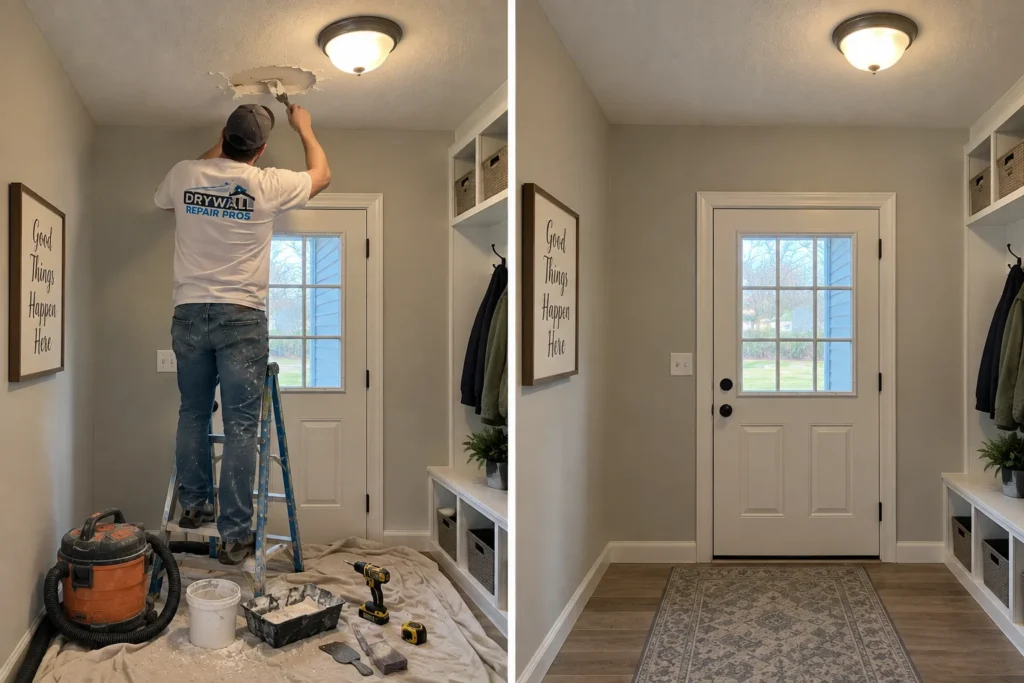
Professional Ceiling Crack Repair in Cedar Rapids & Iowa City
Cracks in a drywall ceiling can be small and cosmetic, or they can keep returning because a joint, patch, fastener, or section of drywall is moving beneath the surface.
Simply filling the visible line may improve the appearance temporarily, but a more durable repair depends on where the crack is located, whether it follows a drywall seam, whether tape has failed, whether the surrounding ceiling is loose, and whether the area has been repaired before.
Drywall Repair Pros provides professional ceiling crack repair for homes, rental properties, apartments, and commercial interiors throughout Cedar Rapids, Iowa City, and surrounding communities.
We repair hairline ceiling cracks, seam and joint cracks, wall-to-ceiling cracks, recurring cracks, cracks around previous ceiling patches, cracks near openings, and cracks associated with normal movement, failed tape, or loose drywall.
Get a Fast Ceiling Crack Repair Quote From Photos
Most visible ceiling cracks can be initially evaluated from clear photos and a few project details. Send a close-up photo, a wider room photo, approximate crack length, ceiling height, whether the crack follows a straight line or seam, whether it has been repaired before, and whether the ceiling is smooth, textured, or popcorn.
If the crack is widening, recurring, associated with sagging, or related to a previous leak or remodeling project, include that information too. In many cases, we can prepare initial pricing the same day without scheduling a separate estimate visit.
Drywall Ceiling Crack Repair
Drywall ceilings are made from panels fastened to framing and finished at their joints. When joints move, tape fails, drywall loosens, or a previous repair becomes unstable, cracks can appear.
Ceiling cracks may also develop away from seams because of framing movement, seasonal expansion and contraction, minor settlement, remodeling changes, roof-framing movement, previous water exposure, or poorly completed repairs.
The visible crack is often only the symptom, so the surrounding area should be considered before the surface is refinished.
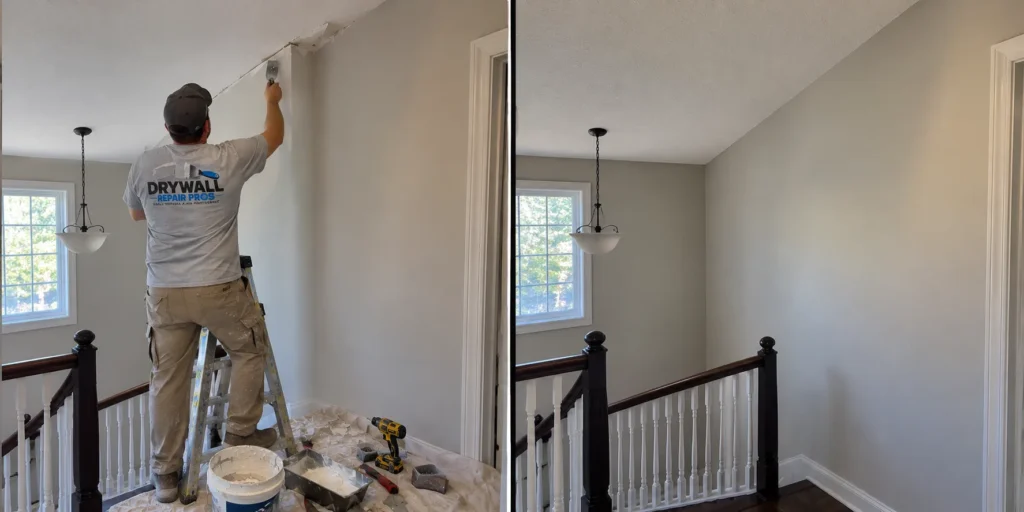
What Causes Cracks in Drywall Ceilings?
Common causes include:
- Normal building movement
- Seasonal expansion and contraction
- Framing shrinkage or minor settlement
- Failed drywall seams or joints
- Loose drywall or inadequate fastening
- Failed drywall tape
- Previous patch failure
- Remodeling or structural changes
- Roof framing or truss movement
- Temperature and humidity changes
- Past moisture-related movement
Many ceiling cracks are ordinary drywall failures. Others deserve additional attention when they are rapidly changing, very large, associated with sagging, or appearing alongside other changes in the building.
Common Ceiling Crack Patterns
Hairline Ceiling Cracks
Hairline cracks may appear along seams, near corners, around fixtures, around previous repairs, or where walls meet ceilings. A thin crack does not automatically mean the ceiling drywall needs replacement. The key question is whether the area is stable.
Ceiling Seam & Joint Cracks
Straight cracks frequently follow the seam where two drywall sheets meet. They may appear as fine lines, wider joint cracks, loose tape, raised compound, or a recurring crack along the same path.
If the seam is moving or the tape has failed, the repair may require opening the damaged joint, stabilizing the area, replacing failed tape, and refinishing rather than simply filling the visible line. For broader seam and joint problems, see Drywall Seam & Joint Repair.
Wall-to-Ceiling & Corner Cracks
Cracks where the wall meets the ceiling or near inside corners can result from seasonal framing movement, roof framing or truss movement, failed corner tape, minor settlement, temperature and humidity changes, or previous repairs.
Because both wall and ceiling framing can influence the joint, these areas may be more prone to recurring cracks than a crack in the middle of a flat surface.
Recurring Ceiling Cracks
A crack that repeatedly returns deserves more attention than a one-time cosmetic defect. Recurring cracks may involve loose drywall, failed tape, inadequate fastening, poor joint preparation, patch movement, framing movement, or seasonal movement.
Repeatedly adding compound over the same crack can build up the surface without correcting the reason it keeps opening.
Diagonal or Stress Cracks
Diagonal or stress cracks often appear near corners, stairwells, structural openings, room transitions, or areas where framing conditions change. Crack direction alone does not prove a structural problem, but large, widening, or rapidly changing cracks may warrant additional evaluation before cosmetic repair.
What the Direction of a Ceiling Crack Can Tell You
The direction of a crack can offer clues about what is happening beneath the finished surface.
- A long straight crack often follows a drywall seam or framing line.
- A horizontal-looking crack may follow a long joint or previous repair strip.
- A diagonal crack near a corner or transition may reflect movement where framing conditions change.
- A crack around a patch may indicate movement between the patch and surrounding ceiling.
Direction is only one clue. The repair decision should also consider crack width, recurrence, nearby sagging, loose drywall, tape failure, and previous repair history.
Want Pricing for a Repair Like This?
Most visible repairs can start with photos. Send the property address, a short description, and up to six images.
Ceiling Cracks Around Previous Patches
Previous ceiling patches can crack around their edges when backing is inadequate, fasteners are insufficient, tape fails, compound shrinks, the patch sits at a different height, or old and new drywall move differently.
If the patch itself is unstable, the repair may need to be rebuilt rather than simply recoated. For patch-specific problems, see Ceiling Hole & Patch Repair.
Cracks Around Ceiling Openings
Cracks sometimes develop around ceiling lights, electrical boxes, recessed fixtures, ceiling fans, attic-access openings, and other modified areas.
These locations may have reduced support, prior cutouts, repeated movement, trim movement, or previous patchwork. The surrounding drywall should be checked for looseness or damaged edges before the crack is refinished.
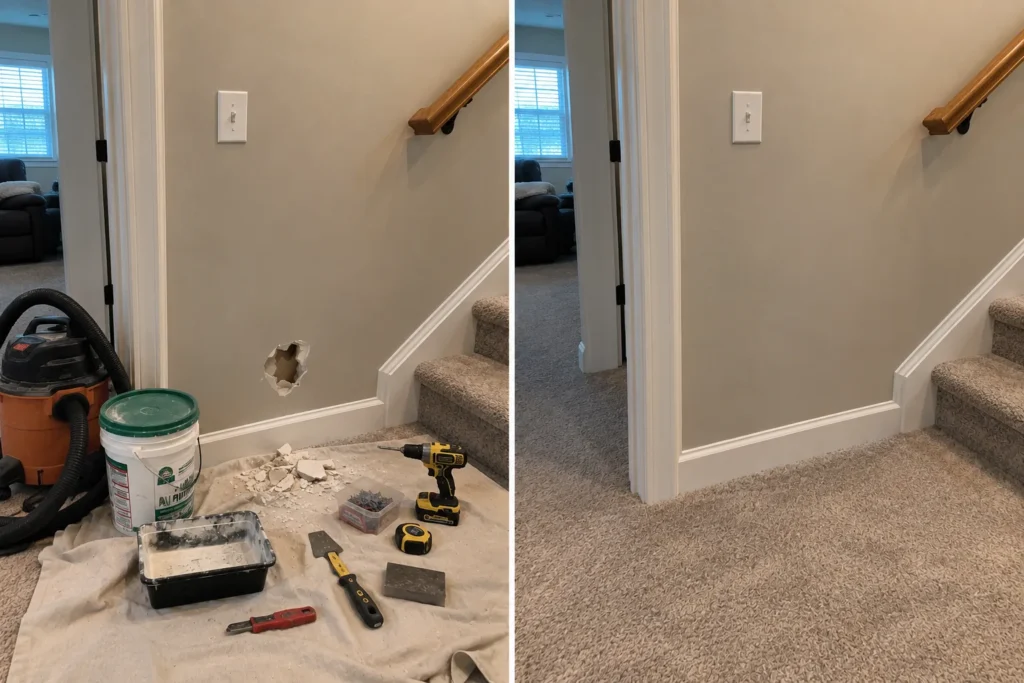
Ceiling Cracks After Remodeling or Wall Removal
Remodeling can change how old and new drywall, framing, and repaired areas interact. Cracks may appear after walls are removed, rooms are opened, structural beams are added, fixtures are relocated, or new drywall is installed next to existing material.
Long repaired strips left after wall removal can crack when backing is weak, joints were not reinforced well, the finish area was too narrow, or movement continues. For broader renovation-related work, see Drywall Repair After Remodeling.
Ceiling Cracks After Water Damage
Moisture can weaken drywall joints, loosen tape, swell gypsum, and contribute to cracking as materials become wet and then dry.
Water-related cracks may appear with stains, bubbling paint, loose tape, sagging, swelling, or soft drywall. The leak should be corrected and the affected area should be appropriately dry before the crack repair is completed.
For ceiling water-damage problems, see Water-Damaged Ceiling Repair. For roof-related damage, see Drywall Repair After Roof Leaks.
Cracks Caused by Loose Ceiling Drywall
Loose ceiling drywall can move slightly around fasteners and framing. That movement may create joint cracks, visible seams, recurring repair failure, nail pops, or screw pops.
If the drywall remains structurally suitable, additional fastening may help stabilize the area before the crack is repaired. For broader loose-ceiling problems, see Sagging & Loose Drywall Repair. For fastener-specific issues, see Nail Pop & Screw Pop Repair.
Smooth, Textured & Popcorn Ceiling Cracks
Smooth Ceiling Cracks
Smooth ceilings make even thin cracks highly visible because there is no texture to break up surface variation. Repairing a smooth ceiling crack requires careful attention to surface flatness, joint buildup, feathering, sanding, and lighting direction.
Textured Ceiling Cracks
Textured ceilings can crack beneath the existing finish. The drywall or joint should be repaired and stabilized first, then the texture can be restored. See Ceiling Texture Repair & Matching for texture-focused work.
Popcorn Ceiling Cracks
Popcorn ceilings may crack along joints, patches, corners, or areas affected by movement or previous water damage. The underlying drywall crack should be repaired first, followed by the popcorn finish where appropriate. See Popcorn Ceiling Repair for popcorn-specific work.
Repair Ceiling Cracks Before Painting or Selling
Paint does not stop drywall movement. If a ceiling crack is painted over without repairing the underlying drywall problem, it may remain visible or reopen later.
Before final painting, the repair should be stable, reinforced when needed, feathered, sanded, textured when applicable, and prepared for the finish coat.
Visible ceiling cracks can also attract attention during showings and listing photography, especially long straight cracks, wall-to-ceiling cracks, recurring repairs, and cracks around previous patches.
Ceiling Crack Repair for Rental Properties
Rental units may develop ceiling cracks from normal movement, previous repairs, maintenance access, fixture changes, remodeling, or past plumbing work.
Landlords and property managers can send close-up and wider photos of multiple cracks together, along with approximate crack length, ceiling height, whether the cracks follow seams, and whether the areas have been repaired before. Most visible ceiling cracks can be reviewed remotely for initial pricing, often the same day.
Commercial Ceiling Crack Repair
Commercial interiors can develop ceiling cracks after tenant improvements, electrical or mechanical work, remodeling, framing movement, or previous repairs. Localized ceiling cracks can often be repaired without replacing an entire ceiling.
Ceiling Crack Repair in Cedar Rapids
Drywall Repair Pros provides ceiling crack repair throughout Cedar Rapids and surrounding communities. Common projects include drywall ceiling crack repair, recurring ceiling crack repair, ceiling seam and joint cracks, wall-to-ceiling cracks, ceiling stress cracks, cracked ceiling drywall, and cracks around previous repairs.
Ceiling Crack Repair in Iowa City
We provide ceiling crack repair throughout Iowa City and surrounding communities for homeowners, landlords, property managers, rental properties, apartments, and commercial interiors. Services include ceiling seam crack repair, recurring ceiling cracks, ceiling joint repair, corner cracks, wall-to-ceiling cracks, stress cracks, and cracked ceiling drywall.
Our Ceiling Crack Repair Process
Start With Photos and Crack Details
Send a close-up photo, a wider room photo, approximate crack length, ceiling height, whether the crack follows a straight line or seam, whether it has been repaired before, whether it keeps returning, whether the ceiling is loose or sagging, and whether the ceiling is smooth, textured, or popcorn.
Identify the Crack Pattern and Likely Cause. We consider the crack location, direction, width, recurrence, nearby joints, tape condition, previous repairs, and whether the ceiling is moving.
Remove Failed Material and Secure Loose Drywall When Needed. Loose compound, failed tape, or unstable material is removed, and sound but loose drywall may be secured before refinishing.
Repair or Reinforce the Joint or Crack. The damaged area is prepared and reinforced as appropriate for the condition beneath the surface.
Finish the Repair in Controlled Layers. Joint compound is applied as needed without creating unnecessary buildup.
Feather and Sand the Repair. The finished area is widened gradually so the transition is less visible under ceiling lighting.
Restore Texture and Prepare the Surface. Smooth, textured, or popcorn surfaces are prepared for the appropriate final finish.
Can a Ceiling Crack Be Permanently Repaired?
Often, yes. A lasting repair is more likely when loose drywall is secured, failed tape is replaced, the joint is properly prepared, the damaged area is reinforced appropriately, and the finished surface is feathered correctly.
No cosmetic drywall repair can guarantee that a building will never move again. If framing or building movement continues, a crack can recur even after a properly completed repair.
When Should a Ceiling Crack Be Investigated Further?
Many ceiling cracks are ordinary drywall or joint failures. Additional evaluation may be appropriate when a crack is:
- Rapidly widening
- Very large
- Appearing suddenly
- Accompanied by sagging
- Associated with doors or windows beginning to stick
- Appearing with several other building changes
- Associated with significant water damage
Drywall repair addresses the finished surface. It does not replace structural or moisture evaluation when those issues are indicated.
Frequently Asked Questions About Ceiling Crack Repair
Can a crack in a drywall ceiling be repaired?
Yes. Many ceiling cracks can be repaired once the crack pattern and condition of the surrounding drywall are understood.
Why does my ceiling keep cracking?
Recurring cracks may result from loose drywall, failed tape, previous repair failure, inadequate fastening, framing movement, joint movement, or seasonal changes.
Why is there a straight crack across my ceiling?
A straight crack often follows a drywall seam, joint, framing line, or previous repair beneath the surface.
Can a ceiling seam crack be repaired?
Yes. A failed joint may need to be stabilized, retaped, reinforced, and refinished rather than simply filled.
Why is my ceiling cracking where it meets the wall?
Movement between wall framing and ceiling framing, roof truss movement, failed corner tape, seasonal changes, or previous repairs can cause cracks at the wall-to-ceiling joint.
Can a recurring ceiling crack be repaired?
Yes, but the reason for the recurring movement should be addressed as part of the repair whenever practical.
Can loose drywall cause ceiling cracks?
Yes. Drywall that moves around fasteners or framing can crack at joints, seams, and previous repair areas.
Can water damage cause ceiling cracks?
Yes. Moisture can weaken joints, loosen tape, swell drywall, and contribute to cracking as materials become wet and dry.
Do ceiling cracks need drywall tape?
Some do. Cracks that follow drywall joints or involve failed tape often require joint reinforcement rather than simple filling.
Does a ceiling crack mean there is a structural problem?
Not necessarily. Many ceiling cracks result from ordinary drywall movement or joint failure. Large, widening, rapidly changing, or widespread cracks may warrant further investigation.
Can ceiling crack repair be quoted from photos?
Usually. Clear close-up and wider photos, approximate crack length, ceiling height, crack direction, surface texture, recurrence, and previous repair history can often provide enough information for initial pricing.
How much does ceiling crack repair cost?
Cost depends on crack length, cause, ceiling height, access, whether tape or joints have failed, whether drywall is loose, existing texture, and previous repair work. See our Drywall Repair Cost & Pricing Guide for broader pricing information.
Get a Fast Ceiling Crack Repair Quote
For most visible ceiling cracks, you can start the pricing process without waiting for a separate on-site estimate. Send clear photos and a few project details so we can review the crack pattern and surrounding ceiling.
For the fastest review, include:
- A close-up photo of the crack
- A wider photo showing where it is located
- Approximate crack length
- Approximate ceiling height
- Whether the crack follows a straight line or seam
- Whether it has been repaired before
- Whether it keeps returning or is getting wider
- Whether the ceiling is loose or sagging
- Whether there has been water damage
- Whether the ceiling is smooth, textured, or popcorn
- Photos of any additional ceiling or wall cracks you want included
In many cases, that is enough information for same-day initial pricing. Drywall Repair Pros serves Cedar Rapids, Iowa City, and surrounding communities. Upload your photos and project details to request your free ceiling crack repair quote.